This page covers superposition of two collinear SHMs. It has three short theory sections, two figures, and three solved PYQs.
1. Same frequency → resultant amplitude and phase
Two vibrations along the same line with the same frequency join into one vibration. Like two people pushing a swing together: the pushes add.
For $y_1 = a_1\sin\omega t$ and $y_2 = a_2\sin(\omega t+\phi)$, the result is $y = A\sin(\omega t+\theta)$ with
Derivation in one line
Expand $y_2 = a_2\sin\omega t\cos\phi + a_2\cos\omega t\sin\phi$. Collect $\sin\omega t$ and $\cos\omega t$ terms, then match with $A\sin(\omega t+\theta) = A\sin\omega t\cos\theta + A\cos\omega t\sin\theta$. Compare coefficients, square and add to eliminate $\theta$: gives $A^2$. Divide to get $\tan\theta$.
Special cases
- $\phi = 0$: $A = a_1 + a_2$ (loudest).
- $\phi = \pi$: $A = |a_1-a_2|$ (quietest).
- $\phi = \pi/2$, equal $a$: $A = a\sqrt{2}$.
2. Different frequencies → beats + mine-gas use
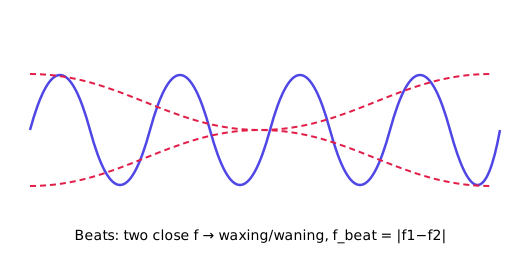
Two nearly equal frequencies go in and out of step. Sound gets loud, then soft, then loud again. Each loud-soft cycle is one beat. Like two fans nearly in sync: the hum swells and fades.
For equal amplitudes $y_1 = a\sin\omega_1 t$, $y_2 = a\sin\omega_2 t$, the sum-to-product identity gives
$$y = 2a\cos!\left(\frac{\Delta\omega,t}{2}\right)\sin(\bar{\omega}t)$$
where $\bar{\omega} = (\omega_1+\omega_2)/2$ is the fast carrier and $\Delta\omega = \omega_1-\omega_2$ is the slow envelope. The amplitude $2a\cos(\Delta\omega t/2)$ swells to $2a$ and sinks to $0$. Intensity $\propto (\text{amplitude})^2$ peaks twice per envelope cycle, so
Mine-gas detector (2022)
A reference tuning fork sounds with a resonator filled with mine air. Clean air gives no beats. Poisonous gas changes the air density, which shifts the resonator frequency by a tiny amount. Even a 1–2 Hz shift gives audible beats. So beats detect gas before instruments show it (the ear hears $|f_1-f_2|$ easily).
3. Sonometer frequency law
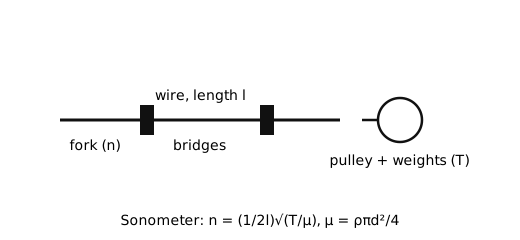
A stretched string sings higher when pulled tighter, shorter, thinner, or lighter. One formula joins all four effects.
Ratio form
Drop constants ($\pi/4$ and $1/2$ cancel in ratios): $n \propto \sqrt{T}/(l,d\sqrt{\rho})$. For two strings: $\dfrac{n_1}{n_2} = \dfrac{l_2}{l_1}\sqrt{\dfrac{T_1}{T_2}}\dfrac{d_2}{d_1}\sqrt{\dfrac{\rho_2}{\rho_1}}$.
Solved PYQs
Find the resultant amplitude and phase due to superposition of $y_1 = 3\sin(50\pi t)$ cm and $y_2 = \sqrt{3}\cos(50\pi t)$ cm.
20192023×2 Recall- $y_2 = \sqrt{3}\cos(50\pi t) = \sqrt{3}\sin(50\pi t + \pi/2)$ (reason: $\cos x = \sin(x+\pi/2)$, so $\phi = \pi/2$).
- $A^2 = 3^2 + (\sqrt{3})^2 + 2(3)(\sqrt{3})\cos(\pi/2) = 9 + 3 + 0 = 12$ (reason: $\cos 90° = 0$ kills the cross term).
- $A = \sqrt{12} = 2\sqrt{3} \approx 3.46$ cm.
- $\tan\theta = (\sqrt{3}\sin 90°)/(3 + \sqrt{3}\cos 90°) = \sqrt{3}/3 = 1/\sqrt{3}$, so $\theta = 30°$ (first quadrant, both numerator and denominator positive).
What are beats? How are they applied in the determination of poisonous gases in mines?
2022 Recall- Define beats: periodic loud-soft pattern from superposition of two close frequencies (reason: Eq. 2 above).
- State the beat formula $f_{\text{beat}} = |f_1 - f_2|$ per second.
- Mine use: a reference tuning fork drives a resonator filled with mine air (reason: density of air sets the resonator frequency).
- Poisonous gas changes the air density, shifts the resonator frequency by a small amount, and the ear hears $|f_1-f_2|$ beats even at 1–2 Hz shift (reason: ear resolves beat rate, not absolute pitch).
Sonometer numerical: tensions in ratio $8:1$, lengths $36:35$, diameters $4:1$, densities $1:2$; higher pitch $360$ Hz. Find beats produced.
2023 Recall- $n_1/n_2 = (l_2/l_1)\sqrt{T_1/T_2}\,(d_2/d_1)\sqrt{\rho_2/\rho_1}$ (reason: ratio form of Formula 3).
- $l_2/l_1 = 35/36$ (reason: invert $36:35$), $\sqrt{T_1/T_2} = \sqrt{8} = 2\sqrt{2}$, $d_2/d_1 = 1/4$, $\sqrt{\rho_2/\rho_1} = \sqrt{2}$.
- Multiply: $n_1/n_2 = (35/36)\times 2\sqrt{2}\times(1/4)\times\sqrt{2} = (35/36)\times(2\times 2/4) = (35/36)\times 1 = 35/36$ (reason: $\sqrt{2}\times\sqrt{2} = 2$).
- $n_1/n_2 < 1$, so $n_2$ is higher; $n_2 = 360$ Hz and $n_1 = 360\times 35/36 = 10\times 35 = 350$ Hz (reason: $360/36 = 10$).
- Beats $= |360 - 350| = 10$ per second.
Reference. Subrahmanyam & Brij Lal — Waves & Oscillations Ch-4 (superposition, beats, sonometer).