A magnet moved near a coil lights a bulb with no battery attached. The cause is the change of magnetic flux; the effect is the induced e.m.f. Lenz law fixes the direction. This page covers every qualitative PYQ in EMI; the inductance numerics live on the companion page.
Laws and definitions
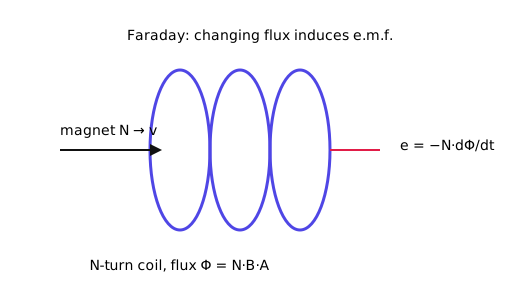
Faraday law 1. Whenever the magnetic flux through a circuit changes, an e.m.f. is induced. The e.m.f. lasts only while the flux changes.
Lenz law. The minus sign in Eq. (1) is Lenz law — the induced current flows so its own field opposes the change that caused it. Energy argument: if it helped the change, we would get free energy (a magnet would accelerate on its own). Since energy is conserved, it must oppose.
Self induction. Flux of a coil due to its own current: $\Phi = LI$. Then $e = -L,dI/dt$. The constant $L$ is called “electric inertia” (see Q4 below).
Mutual induction. Flux in coil 2 due to current in coil 1: $\Phi_2 = MI_1$. Then $e_2 = -M,dI_1/dt$.
Solved PYQs
Q120192022×2
State (and explain) Faraday's laws of electromagnetic induction.
Recall
Steps
- Law 1: change of flux through a coil induces an e.m.f.; no change → no e.m.f. (Reason: experiment with moving magnet and coil.)
- Law 2: $e = -d\Phi/dt$ for one turn; $e = -N\,d\Phi/dt$ for $N$ turns. The minus sign is Lenz law (opposition).
- Explain symbols: $\Phi = BA\cos\theta$ in weber (Wb), $t$ in seconds, $e$ in volts.
- Faster change gives bigger e.m.f.; the e.m.f. exists only while the flux is changing.
Answer
Exam tip
Q22018
Write down the integral and differential forms of Faraday's law.
Recall
Steps
- Integral form: $\oint\vec{E}\cdot d\vec{l} = -d\Phi/dt$ — induced $\vec{E}$ integrated round the loop is the e.m.f.
- Apply Stokes: $\oint\vec{E}\cdot d\vec{l} = \int(\nabla\times\vec{E})\cdot d\vec{S}$.
- Write flux as surface integral: $\Phi = \int\vec{B}\cdot d\vec{S}$, so $-d\Phi/dt = -\int(\partial\vec{B}/\partial t)\cdot d\vec{S}$.
- The two surfaces are arbitrary and identical, so the integrands must match: $\nabla\times\vec{E} = -\partial\vec{B}/\partial t$.
- This holds at every point even with no wire present — it is a statement about fields, not a circuit.
Answer
Exam tip
Q320182023×2
What do you mean by non-inductive coil?
Recall
Steps
- Construction: bifilar winding — the wire is doubled back on itself; current goes out in one strand and returns in the neighbour.
- Effect: the two strands carry equal and opposite currents, so their magnetic fields cancel inside the coil.
- Result: net flux $\approx 0$, so $L \approx 0$ and the induced e.m.f. $e = -L\,dI/dt \approx 0$.
- Use: resistance boxes and standard resistors, where we want pure resistance with no inductive kick when the current changes.
Answer
Exam tip
Q42019
Define self induction. Why is it called electric inertia?
Recall
Steps
- Definition: self induction is the induction of e.m.f. in a coil by the change of its own current: $e = -L\,dI/dt$.
- Inertia parallel: $L$ opposes the rise or fall of current, just as mass $m$ opposes the rise or fall of velocity.
- Examples: at switch-on $L$ holds current back; at switch-off $L$ tries to keep current going (spark across the switch).
- Energy parallel: $U = \tfrac{1}{2}LI^2$ matches $K = \tfrac{1}{2}mv^2$ — work done against the induced e.m.f. is stored in the field.
Answer
Exam tip
Q52022
Define coefficients of self and mutual inductance.
Recall
Steps
- Self inductance: $L = \Phi/I$ for a coil's own flux linked with its own current. Also $e = -L\,dI/dt$.
- Mutual inductance: $M = \Phi_2/I_1$ — flux linked with coil 2 per ampere in coil 1. Also $e_2 = -M\,dI_1/dt$.
- Units and dependence: $[L] = [M] = 1$ H = 1 Wb/A. $L$ depends on turns, area, length and core; $M$ depends on the same plus coupling and distance between coils.
- Coupling factor $k = M/\sqrt{L_1 L_2}$ lies between 0 and 1 (perfect coupling $k=1$).
Answer
Exam tip
Reference. Brij Lal & Subrahmanyam Ch-10; H.C. Verma Vol-1 Ch-38; S.L. Arora Vol-1 Ch-6.