This page applies Gauss's law to common charge distributions. We derive the field of a uniformly charged solid sphere (outside and inside), an infinite line charge (cylinder), and solve the zero-field-point problem for two like charges. Each application starts by naming the right Gaussian surface.
1. Uniformly charged solid sphere
Sphere of radius $R$ carries total charge $Q$ spread uniformly through its volume. Volume charge density $\rho = Q/(\tfrac{4}{3}\pi R^3)$. Symmetry: there is no preferred direction, so the field is purely radial and depends only on $r$.
1.1 Outside the sphere ($r > R$)
Take a concentric Gaussian sphere of radius $r$. It encloses the full charge $Q$. Apply Gauss's law: $E\cdot 4\pi r^2 = Q/\varepsilon_0$.
1.2 Inside the sphere ($r < R$)
The Gaussian sphere of radius $r$ encloses only the charge inside that radius. Volume scales as $r^3$, so $Q_{\text{in}} = Q\,(r/R)^3 = Q\,r^3/R^3$. Apply Gauss's law: $E\cdot 4\pi r^2 = Q\,r^3/\varepsilon_0 R^3$.
2. Other Gauss-law results
Each result comes from choosing the Gaussian surface that matches the symmetry of the charge distribution.
Solved PYQs
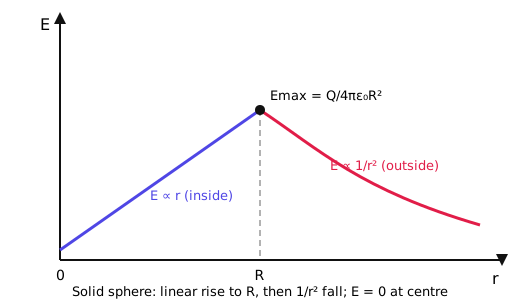
Using Gauss's law, find the field of a uniformly charged solid sphere outside and inside. Show the graphical variation and prove the field is zero inside (at the centre).
×220182023Recall
Steps
- State the symmetry: $\vec{E} = E(r)\hat{r}$, so on a concentric Gaussian sphere, $\Phi = E(r)\cdot 4\pi r^2$.
- Outside ($r > R$): enclosed charge is the full $Q$; Gauss's law gives $E = Q/4\pi\varepsilon_0 r^2$ (point-charge form).
- Inside ($r < R$): enclosed charge scales with volume, $Q_{\text{in}} = Q\,r^3/R^3$; Gauss's law gives $E = Q\,r/4\pi\varepsilon_0 R^3$ (linear in $r$).
- At the centre ($r = 0$): Eq. (2) gives $E = 0$. For a thin shell, $Q_{\text{in}} = 0$ everywhere inside, so $E = 0$ throughout.
- Graph: straight line from origin to $(R, E_{\max})$, then a $1/r^2$ falling curve — as in Fig 1.1.
Answer
Exam tip
Calculate the electric field on the surface of a $^{238}_{92}$U nucleus (radius $7\times 10^{-15}$ m). Take $\varepsilon_0 = 8.85\times 10^{-12}$ C²/N·m², $e = 1.6\times 10^{-19}$ C.
2018Recall
Steps
- Charge of the nucleus: $Q = 92\,e = 92\times 1.6\times 10^{-19} = 1.472\times 10^{-17}$ C (reason: 92 protons).
- At the surface $r = R$: $E = \dfrac{1}{4\pi\varepsilon_0}\dfrac{Q}{R^2}$ with $1/4\pi\varepsilon_0 = 9\times 10^9$ N·m²/C².
- Numerator: $9\times 10^9\times 1.472\times 10^{-17} = 1.3248\times 10^{-7}$ N·m²/C.
- Denominator: $R^2 = (7\times 10^{-15})^2 = 49\times 10^{-30}$ m².
- Divide: $E = \dfrac{1.3248\times 10^{-7}}{49\times 10^{-30}} = 2.7\times 10^{21}$ N/C, radially outward (reason: positive charge pushes a test charge away).
Answer
Exam tip
Using Gauss's theorem, find the electric field intensity at a point due to a charged cylinder (long line of charge).
2022Recall
Steps
- Let charge per unit length be $\lambda$. Draw a coaxial Gaussian cylinder of radius $r$ and length $l$.
- Flux through the curved face only: $\Phi = E\cdot 2\pi r l$ (reason: $\vec{E}\parallel d\vec{S}$ on curved face; on caps $\vec{E}\perp d\vec{S}$, so they contribute 0).
- Enclosed charge: $Q_{\text{in}} = \lambda l$. Apply Gauss's law: $E\cdot 2\pi r l = \lambda l/\varepsilon_0$.
- Cancel $l$: $E = \lambda/2\pi\varepsilon_0 r$, radially outward (reason: charge is positive).
Answer
Exam tip
Two charges $8\ \mu$C and $2\ \mu$C are placed 50 cm apart in air. At which point is the electric field intensity zero?
2023Recall
Steps
- Let the point be at distance $x$ from $8\ \mu$C along the line joining the charges, so it is $(50 - x)$ cm from $2\ \mu$C. Between them the two fields point in opposite directions (reason: each charge pushes a test charge away from itself).
- Set the magnitudes equal: $\dfrac{k\cdot 8}{x^2} = \dfrac{k\cdot 2}{(50-x)^2}$. Cancel $k$: $\dfrac{8}{x^2} = \dfrac{2}{(50-x)^2}$.
- Take square roots (cleaner than expanding squares): $\dfrac{\sqrt{8}}{x} = \dfrac{\sqrt{2}}{50-x}$ → $\dfrac{2\sqrt{2}}{x} = \dfrac{\sqrt{2}}{50-x}$ → $\dfrac{2}{x} = \dfrac{1}{50-x}$.
- Cross-multiply: $2(50 - x) = x$ → $100 - 2x = x$ → $3x = 100$ → $x = 33.3$ cm.
- Check: from $2\ \mu$C, the distance is $50 - 33.3 = 16.7$ cm. Verify: $8/(33.3)^2 \approx 2/(16.7)^2 \approx 0.0072$. ✓
Answer
Exam tip
Reference. Brij Lal & Subrahmanyam, Electricity & Magnetism Ch-2 (Gauss applications: sphere, line, shell, sheet, conductor); S.L. Arora Vol-1 Ch-1.