This page covers Gauss's law in electrostatics. We define electric flux, state the theorem, and prove it step-by-step. The proof is the most repeated question in Section 1 (asked 4 times across 2018–2023), so the full derivation is given here.
1. Electric flux
Flux counts how many field lines cross a surface. Take a small patch $d\vec{S}$ on the surface — its arrow is the outward normal. The flux through the patch is $d\Phi = \vec{E}\cdot d\vec{S} = E\,dS\cos\theta$. Adding all patches gives the total flux through the surface:
The circle on the integral $\oint$ means the surface is closed. Think of the closed surface as a net that catches field lines.
2. Gauss's theorem — statement
For any closed surface in electrostatics, the total outward flux equals the enclosed charge divided by $\varepsilon_0$:
3. Gauss's theorem — proof
We use Coulomb's result: the field of a point charge $Q$ at distance $r$ is $\vec{E} = \dfrac{Q}{4\pi\varepsilon_0 r^2}\hat{r}$ (radially outward).
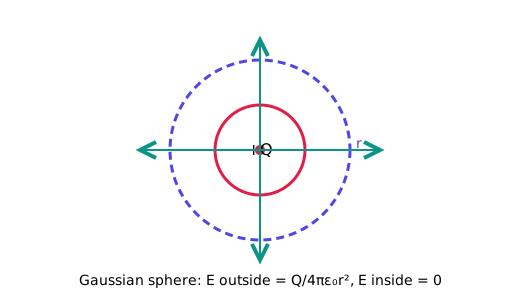
3.1 Proof for a spherical surface
Take a sphere of radius $r$ centred on the charge $Q$. Every point on the sphere is at distance $r$ from $Q$.
- On the sphere, $\vec{E}\parallel d\vec{S}$, so $\vec{E}\cdot d\vec{S} = E\,dS$ (reason: $\cos 0° = 1$).
- $E$ is constant on the sphere (reason: every point is at the same distance $r$ from $Q$).
- Take $E$ outside the integral: $\Phi = E\oint dS = E\cdot 4\pi r^2$ (reason: area of sphere is $4\pi r^2$).
- Substitute $E$: $\Phi = \dfrac{Q}{4\pi\varepsilon_0 r^2}\cdot 4\pi r^2 = \dfrac{Q}{\varepsilon_0}$ (reason: the $r^2$ cancels — area grows as $r^2$, field falls as $1/r^2$).
This proves Gauss's law for one charge inside a sphere.
3.2 Proof for any closed surface
Now consider a closed surface of any shape around the same charge $Q$. A small patch $dS$ at distance $r$ from $Q$, with its normal making angle $\theta$ with $\hat{r}$, subtends a solid angle $d\Omega = dS\cos\theta/r^2$. The flux through it is:
- Flux through patch: $d\Phi = E\cos\theta\,dS = \dfrac{Q}{4\pi\varepsilon_0 r^2}\cdot \dfrac{\cos\theta\,dS}{1}$ (reason: $E = Q/4\pi\varepsilon_0 r^2$).
- Rewrite as $d\Phi = \dfrac{Q}{4\pi\varepsilon_0}\cdot \dfrac{dS\cos\theta}{r^2} = \dfrac{Q}{4\pi\varepsilon_0}\,d\Omega$ (reason: definition of solid angle).
- Integrate over the closed surface: $\Phi = \dfrac{Q}{4\pi\varepsilon_0}\oint d\Omega = \dfrac{Q}{4\pi\varepsilon_0}\cdot 4\pi = \dfrac{Q}{\varepsilon_0}$ (reason: closed surface subtends $4\pi$ sr).
- The shape does not change the answer — only the enclosed charge matters.
3.3 Proof for many charges (superposition)
If there are $n$ charges $Q_1, Q_2, \dots, Q_n$ inside the surface, the total field is the sum $\vec{E} = \sum_i \vec{E}_i$ by superposition.
- Total flux: $\Phi = \oint \vec{E}\cdot d\vec{S} = \oint \sum_i \vec{E}_i\cdot d\vec{S} = \sum_i \oint \vec{E}_i\cdot d\vec{S}$ (reason: linearity of the integral).
- Each $\oint \vec{E}_i\cdot d\vec{S} = Q_i/\varepsilon_0$ by the single-charge proof above.
- Add: $\Phi = \sum_i Q_i/\varepsilon_0 = Q_{\text{in}}/\varepsilon_0$ (reason: sum of enclosed charges is $Q_{\text{in}}$).
- Charges outside contribute zero net flux: every line that enters the closed surface also leaves it.
4. Differential form of Gauss's law
Shrink the closed surface to a point. Use the divergence theorem $\oint \vec{E}\cdot d\vec{S} = \int (\nabla\cdot\vec{E})\,dV$ and write $Q_{\text{in}} = \int \rho\,dV$. Both sides of Gauss's law become volume integrals, so the integrands must be equal at every point:
Solved PYQs
State and prove Gauss's theorem in electrostatics. Write its differential form.
×42018201920222023Recall
Steps
- State Gauss's law: $\oint \vec{E}\cdot d\vec{S} = Q_{\text{in}}/\varepsilon_0$, where $Q_{\text{in}}$ is the net charge inside.
- Prove for a sphere: $\vec{E}\parallel d\vec{S}$, $E$ is constant on the sphere, so $\Phi = E\cdot 4\pi r^2 = Q/\varepsilon_0$ (the $r^2$ cancels).
- Extend to any closed surface using solid angle: $\Phi = (Q/4\pi\varepsilon_0)\oint d\Omega = (Q/4\pi\varepsilon_0)(4\pi) = Q/\varepsilon_0$, shape-independent.
- Extend to many charges by superposition: $\vec{E} = \sum \vec{E}_i$ so $\Phi = \sum Q_i/\varepsilon_0 = Q_{\text{in}}/\varepsilon_0$; charges outside give zero net flux.
- Differential form: apply divergence theorem to shrink the surface, equate integrands to get $\nabla\cdot\vec{E} = \rho/\varepsilon_0$.
Answer
Exam tip
What do you mean by electric flux? What is the flux through a closed surface enclosing an electric dipole?
2022Recall
Steps
- Define flux by $\Phi = \oint \vec{E}\cdot d\vec{S}$: it counts field lines crossing a closed surface; unit N·m²/C.
- A dipole has $+q$ at one end and $-q$ at the other, so net enclosed charge $Q_{\text{in}} = (+q) + (-q) = 0$ (reason: equal and opposite).
- Apply Gauss's law: $\Phi = Q_{\text{in}}/\varepsilon_0 = 0/\varepsilon_0 = 0$ (reason: as many lines enter the surface as leave it).
Answer
Exam tip
Reference. Brij Lal & Subrahmanyam, Electricity & Magnetism Ch-2 (flux, Gauss theorem, differential form).