This page covers the equations side of Maxwell’s theory. It has four short theory sections, one figure, and five solved PYQs.
1. Conduction current vs displacement current
In a wire charges move. That is conduction current. In the gap of a charging capacitor no charges move, but the electric field between the plates changes with time. Maxwell said this changing field acts like a current. That is displacement current.
Capacitor-gap argument
Take a capacitor charging with current $I_c$. Draw an Amperian loop around the wire. Surface 1 cuts the wire: current through it is $I_c$. Surface 2 passes through the gap between the plates: conduction current through it is zero, but the electric flux $\Phi_E = EA$ grows with time. So $I_d$ in the gap continues the conduction current in the wire.
$$I_d = \varepsilon_0\frac{d\Phi_E}{dt} = \frac{dQ}{dt} = I_c$$
Unit check
$[\varepsilon_0,\partial E/\partial t] = (\text{C}^2/\text{N·m}^2)(\text{N/C·s}) = \text{C/s·m}^2 = \text{A/m}^2$, same as $J_c$. Correct.
2. Ampere law for non-steady currents + Maxwell correction
Old Ampere law $\oint\vec{B}\cdot d\vec{l} = \mu_0 I$ works for steady currents only. For a charging capacitor the same loop gives two answers, so it must be corrected.
Derivation of the correction
Take divergence of $\nabla\times\vec{B} = \mu_0\vec{J}$. The left side is zero (div of a curl is zero). So $\nabla\cdot\vec{J} = 0$. But continuity says
$$\nabla\cdot\vec{J} + \frac{\partial\rho}{\partial t} = 0$$
For non-steady currents $\partial\rho/\partial t \ne 0$, so Ampere law contradicts continuity. Fix: use Gauss law $\nabla\cdot\vec{E} = \rho/\varepsilon_0$ to replace $\rho$. Then
$$\nabla\times\vec{B} = \mu_0\vec{J} + \mu_0\varepsilon_0\frac{\partial\vec{E}}{\partial t}$$
This is the Ampere–Maxwell law. The integral form is $\oint\vec{B}\cdot d\vec{l} = \mu_0(I_c + I_d)$.
Unit check
$[\mu_0\varepsilon_0,\partial E/\partial t] = \text{T/m}$, same as $\nabla\times\vec{B}$. Correct.
3. All four Maxwell equations
Four laws that contain all of electricity and magnetism.
| No. | Name | Differential form | Meaning |
|---|---|---|---|
| 1 | Gauss law (E) | $\nabla\cdot\vec{E} = \rho/\varepsilon_0$ | Charges are sources of $\vec{E}$ |
| 2 | Gauss law (B) | $\nabla\cdot\vec{B} = 0$ | No magnetic monopoles |
| 3 | Faraday law | $\nabla\times\vec{E} = -\partial\vec{B}/\partial t$ | Changing $\vec{B}$ makes a curly $\vec{E}$ |
| 4 | Ampere–Maxwell | $\nabla\times\vec{B} = \mu_0\vec{J} + \mu_0\varepsilon_0,\partial\vec{E}/\partial t$ | Currents + changing $\vec{E}$ make a curly $\vec{B}$ |
In a material medium, replace $\varepsilon_0 \to \varepsilon = K\varepsilon_0$ and $\mu_0 \to \mu$, with $\vec{D} = \varepsilon\vec{E}$ and $\vec{H} = \vec{B}/\mu$: $\nabla\cdot\vec{D} = \rho_f$, $\nabla\cdot\vec{B} = 0$, $\nabla\times\vec{E} = -\partial\vec{B}/\partial t$, $\nabla\times\vec{H} = \vec{J}_f + \partial\vec{D}/\partial t$.
4. EM wave equation in free space + speed of light
In free space ($\rho = 0$, $\vec{J} = 0$) the two curl equations combine to give a wave whose speed is the speed of light.
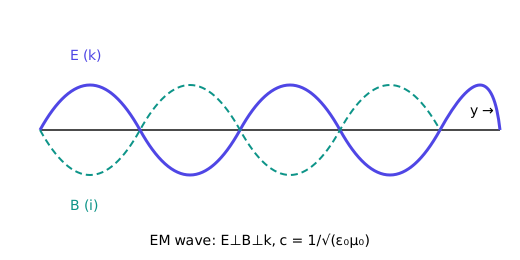
Quick derivation steps
In free space Faraday and Ampere–Maxwell give
$$\nabla\times\vec{E} = -\frac{\partial\vec{B}}{\partial t}, \qquad \nabla\times\vec{B} = \mu_0\varepsilon_0\frac{\partial\vec{E}}{\partial t}$$
Take curl of Faraday (to remove $\vec{B}$): $\nabla\times(\nabla\times\vec{E}) = -\partial(\nabla\times\vec{B})/\partial t$. Left side by identity $\nabla\times(\nabla\times\vec{E}) = \nabla(\nabla\cdot\vec{E}) - \nabla^2\vec{E}$. In free space $\nabla\cdot\vec{E} = 0$, so left side $= -\nabla^2\vec{E}$. Right side using Ampere–Maxwell $= -\mu_0\varepsilon_0,\partial^2\vec{E}/\partial t^2$. Equate:
$$\nabla^2\vec{E} = \mu_0\varepsilon_0\frac{\partial^2\vec{E}}{\partial t^2}$$
Compare with $\nabla^2 f = (1/v^2)\partial^2 f/\partial t^2$. So $1/v^2 = \mu_0\varepsilon_0$ and $c = 1/\sqrt{\mu_0\varepsilon_0}$. Putting $\mu_0 = 4\pi\times 10^{-7}$ H/m, $\varepsilon_0 = 8.85\times 10^{-12}$ F/m gives $c \approx 3.00\times 10^8$ m/s.
Solved PYQs
What do you mean by conduction current and displacement current?
2022 Recall- Define $\vec{J}_c = \sigma\vec{E}$ with $\sigma$ = conductivity (reason: charge flow per unit area).
- Define $\vec{J}_d = \varepsilon_0\,\partial\vec{E}/\partial t$ (reason: Maxwell added this so Ampere law also works for non-steady currents).
- Show on a charging capacitor that $I_d = \varepsilon_0\,d\Phi_E/dt = dQ/dt = I_c$ (reason: flux $\Phi_E = Q/\varepsilon_0$ grows as charge builds up, so the gap current matches the wire current).
Alternating emf $E = E_0\cos\omega t$ of frequency $10^{15}$ Hz applied to a conductor ($\sigma = 10^7$ mho/m). Ratio of conduction to displacement current?
2019 Recall- $\omega = 2\pi f = 2\pi\times 10^{15} = 6.28\times 10^{15}$ rad/s (reason: $\omega = 2\pi f$).
- $\varepsilon_0\omega = (8.85\times 10^{-12})(6.28\times 10^{15}) = 5.56\times 10^4$ S/m (reason: multiply).
- $J_c/J_d = \sigma/(\varepsilon_0\omega) = 10^7/(5.56\times 10^4) = 179.9 \approx 180$ (reason: divide).
Can we apply Ampere's law for non-steady currents? What is Maxwell's correction in this context?
2021 Recall- Show the contradiction at the capacitor gap: surface through wire gives $I_c$, surface through gap gives $0$ for the same loop (reason: conduction current is broken across the gap).
- Add the term $\mu_0\varepsilon_0\,\partial\vec{E}/\partial t$ (reason: Gauss law lets this term carry the divergence, restoring $\nabla\cdot(\vec{J}+\varepsilon_0\,\partial\vec{E}/\partial t) = 0$).
- Write the new integral form $\oint\vec{B}\cdot d\vec{l} = \mu_0(I_c + \varepsilon_0\,d\Phi_E/dt)$.
Write down Maxwell's equations (free space / with symbols / inside material / with Maxwell's modification of Ampère's law).
20182019202020222023×5 Recall- Gauss-E: $\nabla\cdot\vec{E} = \rho/\varepsilon_0$ (reason: charges are sources of $\vec{E}$).
- Gauss-B: $\nabla\cdot\vec{B} = 0$ (reason: no magnetic monopoles, field lines close).
- Faraday: $\nabla\times\vec{E} = -\partial\vec{B}/\partial t$ (reason: changing $\vec{B}$ drives an emf).
- Ampere–Maxwell: $\nabla\times\vec{B} = \mu_0\vec{J} + \mu_0\varepsilon_0\,\partial\vec{E}/\partial t$ (reason: currents + changing $\vec{E}$ make $\vec{B}$).
- Inside a material: replace $\varepsilon_0 \to \varepsilon$, $\mu_0 \to \mu$, write $\vec{D} = \varepsilon\vec{E}$, $\vec{H} = \vec{B}/\mu$: $\nabla\cdot\vec{D} = \rho_f$, $\nabla\cdot\vec{B} = 0$, $\nabla\times\vec{E} = -\partial\vec{B}/\partial t$, $\nabla\times\vec{H} = \vec{J}_f + \partial\vec{D}/\partial t$.
From Maxwell's equations derive the EM wave equation in free space; express the speed in terms of $\varepsilon_0$ and $\mu_0$.
20182022×2 Recall- Write free-space equations: $\nabla\times\vec{E} = -\partial\vec{B}/\partial t$, $\nabla\times\vec{B} = \mu_0\varepsilon_0\,\partial\vec{E}/\partial t$.
- Take curl of Faraday: $\nabla\times(\nabla\times\vec{E}) = -\partial(\nabla\times\vec{B})/\partial t$ (reason: need $\nabla\times\vec{B}$, which Ampere law gives).
- Left side by identity $= \nabla(\nabla\cdot\vec{E}) - \nabla^2\vec{E}$; in free space $\nabla\cdot\vec{E} = 0$, so left side $= -\nabla^2\vec{E}$ (reason: Gauss law with $\rho = 0$).
- Right side using Ampere law $= -\partial(\mu_0\varepsilon_0\,\partial\vec{E}/\partial t)/\partial t = -\mu_0\varepsilon_0\,\partial^2\vec{E}/\partial t^2$.
- Equate and cancel minus: $\nabla^2\vec{E} = \mu_0\varepsilon_0\,\partial^2\vec{E}/\partial t^2$.
- Compare with wave form: $1/v^2 = \mu_0\varepsilon_0$, so $c = 1/\sqrt{\mu_0\varepsilon_0}$. Putting $\mu_0 = 4\pi\times 10^{-7}$ H/m, $\varepsilon_0 = 8.85\times 10^{-12}$ F/m gives $c \approx 3.00\times 10^8$ m/s.
Reference. Brij Lal & Subrahmanyam Ch-11 (Maxwell equations, displacement current); Ajoy Ghatak Ch-7 (wave equation).