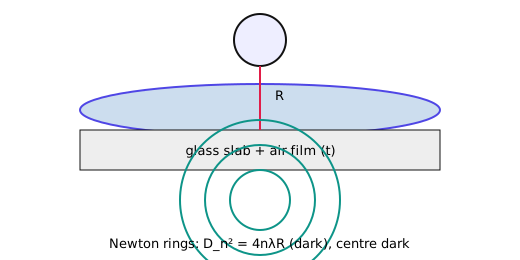
A curved lens rests on a flat glass plate. The thin air film between them gives round dark and bright rings. Daily example: the colour rings you see when a lens presses on glass. Centre is dark.
Here $R$ = radius of curvature of the lens surface. $t$ = air-film thickness at ring radius $r$. $D_n = 2r_n$ = diameter of the $n$-th ring. $\lambda$ = wavelength. $\Delta$ = effective path difference (includes one Stokes $\lambda/2$).
Formation and derivation (no jumps)
Step 1 — Setup. A plano-convex lens of large radius $R$ sits on a flat glass plate. An air film of thickness $t$ (zero at contact, growing outward) lies between them. Monochromatic light falls from above at near-normal incidence.
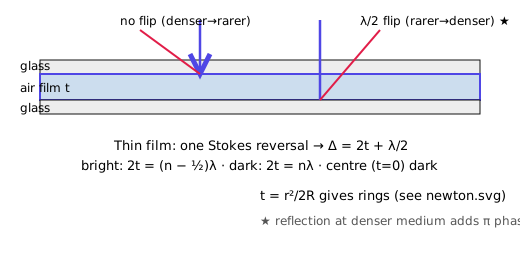
Step 2 — Two reflections. Ray reflects (a) at the top of the film — glass→air: denser→rarer — NO phase flip, and (b) at the bottom of the film — air→glass: rarer→denser — phase flip of $\pi$, i.e. extra path $\lambda/2$ by Stokes’ rule.
Step 3 — Effective path difference. Geometric round trip is $2t$ (down and up, normal incidence so $\cos r = 1$). Add the one flip: $\Delta = 2t + \lambda/2$.
Step 4 — Bright/dark conditions. Bright: $\Delta = n\lambda \Rightarrow 2t = (n-\tfrac12)\lambda$. Dark: $\Delta = (2n-1)\lambda/2 \Rightarrow 2t = n\lambda$. At the centre $t = 0$, $\Delta = \lambda/2$ — destructive, hence centre is dark.
Step 5 — Film geometry $t = r^2/2R$. From the lens circle: $R^2 = r^2 + (R-t)^2 = r^2 + R^2 - 2Rt + t^2$. Cancel $R^2$: $r^2 = 2Rt - t^2 \approx 2Rt$ (since $t \ll R$, drop $t^2$). So $t = r^2/2R$.
Step 6 — Ring diameters. Dark: $2(r_n^2/2R) = n\lambda \Rightarrow r_n^2 = n\lambda R \Rightarrow D_n^2 = 4n\lambda R$ (exact). Bright: $r_n^2 = (n-\tfrac12)\lambda R \Rightarrow D_n^2 = 4(n-\tfrac12)\lambda R$.
Unit check: $[4n\lambda R] = L\cdot L = L^2$, an area — correct for $D_n^2$. Limit: $R \to \infty$ (flat plate) gives no rings ($t$ constant) — sensible.
Trap: transmitted rings are opposite (centre bright — no flip there). If the question says “reflected”, centre is dark.
Solved PYQs
Write down the characteristics of Newton's rings.
2024Recall
Steps
- Rings are circular and concentric, centred on the contact point — because $t$ depends only on radius $r$.
- Centre is dark in reflected light — at $t = 0$, $\Delta = \lambda/2$ which is destructive.
- Rings crowd together outward — width falls as $1/\sqrt{n}$ because $r_n \propto \sqrt{n}$.
- With white light, coloured rings appear (few) — violet inside, red outside — because $r_n \propto \sqrt{\lambda}$.
- $D_n^2$ grows linearly with $n$ — a straight-line graph of $D_n^2$ vs $n$ with slope $4\lambda R$.
Answer
Exam tip
Explain the formation of Newton's rings. Deduce the expression for the diameter (radius) of the $n$-th bright and dark ring by reflection in an air film.
20192022×2Recall
Steps
- Setup + two reflections: $\Delta = 2t + \lambda/2$ because the air→glass face adds $\lambda/2$ (Stokes).
- Bright $2t = (n-\tfrac12)\lambda$, dark $2t = n\lambda$, centre dark (substitute $n = 0$ in dark condition).
- Geometry: $R^2 = r^2 + (R-t)^2$, drop $t^2$ because $t \ll R$, giving $t = r^2/2R$.
- Substitute: $D_n^2 = 4n\lambda R$ for dark rings (exact); bright rings use $n \to n-\tfrac12$.
- State validity: normal incidence, monochromatic light, air film ($\mu = 1$), $R \gg t$.
Answer
Exam tip
In Newton's rings $R = 100$ cm; the diameter of the 3rd ring is $0.181$ cm and the diameter of the 13th ring is $0.501$ cm. Find the wavelength of light used.
2019Recall
Steps
- Given: $R = 100$ cm, $D_3 = 0.181$ cm, $D_{13} = 0.501$ cm, $m-n = 13-3 = 10$.
- Difference form: $D_{13}^2 - D_3^2 = 4(13-3)\lambda R = 40\lambda R$.
- Rearrange: $\lambda = (D_{13}^2 - D_3^2)/40R$.
- Arithmetic: $D_{13}^2 = 0.501^2 = 0.251001$; $D_3^2 = 0.181^2 = 0.032761$; difference $= 0.218240$ cm$^2$; denominator $40 \times 100 = 4000$ cm; $\lambda = 0.218240/4000 = 5.456 \times 10^{-5}$ cm.
- Sense: $5.456 \times 10^{-5}$ cm $= 545.6$ nm $\approx 546$ nm — green-yellow light, visible (400–700 nm).
Answer
Exam tip
Reference. Brij Lal, Subrahmanyam & Avadhanulu — Optics Ch-15 (thin films, Newton rings, Stokes rule); Ajoy Ghatak — Optics Ch-14.