Biot–Savart law is the magnetic version of Coulomb law. A tiny piece of current $I,d\vec{l}$ makes a tiny magnetic field $d\vec{B}$. We add (integrate) all such pieces to get the total field of any wire or loop.
Direction rule. Grip the wire with the right hand, thumb along the current. The fingers curl along $\vec{B}$ (concentric circles round the wire). The cross product gives the sense without ambiguity.
Unit check. $[\mu_0 I,dl/r^2] = (\text{N/A}^2)(\text{A}\cdot\text{m})/\text{m}^2 = \text{N/(A·m)} = \text{tesla (T)}$. Correct.
Straight wire — field at distance r
Take an infinite straight wire along the $z$-axis. A point P sits at perpendicular distance $r$. Each current element contributes a piece of field. After integration (substitute $l = r\tan\phi$) the field forms complete loops around the wire with magnitude
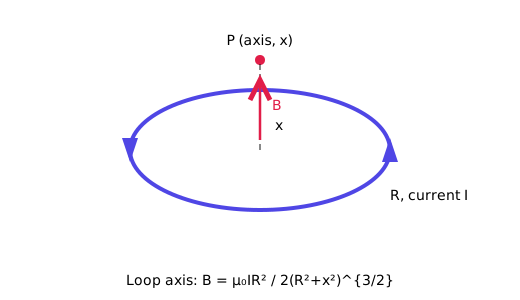
Circular loop — field on the axis
Take a loop of radius $R$ carrying current $I$. Look at a point P on the axis at distance $x$ from the centre. By symmetry the perpendicular components cancel in pairs. Only the axial component survives. Integrating round the loop gives
At the centre ($x=0$) this reduces to $B = \mu_0 I/2R$. Far away ($x \gg R$) it falls as $1/x^3$, the dipole behaviour.
Solved PYQs
Q1201820192022×3
State Biot–Savart's law in magnetostatics.
Recall
Steps
- Write the law in vector form: $d\vec{B} = (\mu_0/4\pi)\,I\,d\vec{l}\times\hat{r}/r^2$.
- Define every symbol: $I$ in A, $d\vec{l}$ in m along the current, $r$ in m, $\hat{r}$ from piece to field point.
- Write the magnitude form: $dB = (\mu_0/4\pi)\,I\,dl\,\sin\theta/r^2$, where $\theta$ is the angle between $d\vec{l}$ and $\hat{r}$.
- State the direction: $\vec{B}$ is perpendicular to the plane of $d\vec{l}$ and $\hat{r}$; right-hand rule fixes the sense.
- Total field of a wire or loop is the integral: $\vec{B} = \int d\vec{B}$.
Answer
Exam tip
Q2201920222023×3
Find the magnetic induction at distance $r$ from a long straight conductor carrying current $I$. (2023 numeric: $I = 1.5$ A, $r = 3$ cm.)
Recall
Steps
- Set geometry: wire along $z$, point P at perpendicular distance $r$, a piece at angle gives $dB = (\mu_0/4\pi)\,I\,dl\,\sin\theta/r'^2$ with $r'$ the slant distance.
- Change variable to angle $\phi$ using $l = r\tan\phi$, so $dl\,\sin\theta/r'^2 = \cos\phi\,d\phi/r$.
- Integrate $\phi$ from $-\pi/2$ to $+\pi/2$ (infinite wire): $B = (\mu_0 I/4\pi r)\int_{-\pi/2}^{\pi/2}\cos\phi\,d\phi = (\mu_0 I/4\pi r)\times 2$.
- Apply the 2023 numbers: $\mu_0/2\pi = 2\times 10^{-7}$ (T·m/A), $I = 1.5$ A, $r = 0.03$ m.
- Compute: $B = 2\times 10^{-7}\times 1.5/0.03 = 3.0\times 10^{-7}/0.03 = 1.0\times 10^{-5}$ T.
Answer
Exam tip
Q320182023×2
Applying Biot–Savart's law, derive $\vec{B}$ at a point on the axis of a current-carrying circular loop.
Recall
Steps
- Geometry: loop radius $R$, current $I$, point P on the axis at distance $x$ from the centre; slant distance $\rho = \sqrt{R^2+x^2}$.
- Field of one piece: $dB = (\mu_0/4\pi)\,I\,dl/\rho^2$ because $d\vec{l}\perp\hat{r}$.
- Keep the axial part: $dB_x = dB\cos\alpha$ with $\cos\alpha = R/\rho = R/\sqrt{R^2+x^2}$ (perpendicular parts cancel by symmetry).
- Integrate round the loop: $\int dl = 2\pi R$, so $B = (\mu_0/4\pi)(I/\rho^2)(R/\rho)(2\pi R) = \mu_0 I R^2/2\rho^3$.
- Centre case $x=0$: substitute to get $B(0) = \mu_0 I/2R$.
Answer
Exam tip
Reference. Brij Lal & Subrahmanyam Ch-7; H.C. Verma Vol-1 Ch-35; S.L. Arora Vol-1 Ch-4.