These 7 questions (B1–B7) appeared in old GE-2 papers (2018, 2019, 2022, 2023) but are not verbatim in the PHYS7021 syllabus text. Your lecturer may or may not ask them. Revise them only after the core magnetostatics and EMI pages are strong. Every solution below is fully worked in SI units.
Constants: $e = 1.6\times 10^{-19}$ C, $\mu_0 = 4\pi\times 10^{-7}$ H/m, $\varepsilon_0 = 8.85\times 10^{-12}$ F/m.
Solved borderline PYQs
B12018
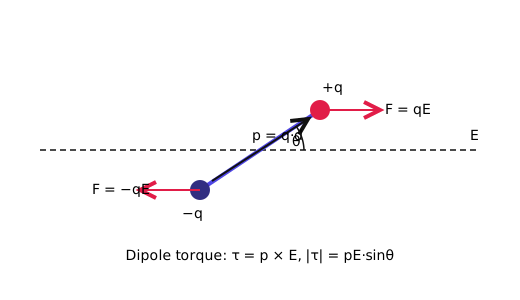
Dipole torque numeric: length 3 cm, charges $5\,\mu$C, $E = 2\times 10^4$ N/C → max and min torque.
Recall
Steps
- Dipole moment: $q = 5\times 10^{-6}$ C, $d = 0.03$ m, so $p = 5\times 10^{-6}\times 0.03 = 1.5\times 10^{-7}$ C·m.
- Maximum torque at $\theta = 90°$, $\sin\theta = 1$: $\tau_{max} = pE = 1.5\times 10^{-7}\times 2\times 10^4 = 3.0\times 10^{-3}$ N·m.
- Minimum torque at $\theta = 0°$, $\sin 0 = 0$: $\tau_{min} = 0$.
Answer
Exam tip
B22023
Explain what happens when an electric dipole is placed in a uniform electric field.
Recall
Steps
- Net force: $\vec{F} = q\vec{E} + (-q\vec{E}) = \vec{0}$. The centre of the dipole does not translate in a uniform field.
- Net torque: $\vec{\tau} = \vec{p}\times\vec{E}$, with $|\tau| = pE\sin\theta$. It rotates the dipole toward $\theta = 0$ (alignment with the field).
- At $\theta = 0$ the torque is zero (stable equilibrium); at $\theta = 180°$ it is zero but unstable.
- A small disturbance from $\theta = 0$ gives torsional SHM (like a pendulum).
Answer
Exam tip
B32023
Dipole ($+1\,\mu$C, $-1\,\mu$C, 2 cm) in field $2.5\times 10^4$ N/C → torque to rotate it by 30°.
Recall
Steps
- Dipole moment: $p = 1\times 10^{-6}\times 0.02 = 2.0\times 10^{-8}$ C·m.
- Torque at 30°: $\tau = 2.0\times 10^{-8}\times 2.5\times 10^4\times \sin 30°$.
- Compute: $\sin 30° = 0.5$, so $\tau = 2.0\times 10^{-8}\times 2.5\times 10^4\times 0.5 = 2.5\times 10^{-4}$ N·m.
Answer
Exam tip
B42019
Lorentz force numeric: $q = 1.6\times 10^{-19}$ C, $\vec{v} = 3\hat{i}+2\hat{j}$ m/s, $\vec{E} = 6\hat{i}+6\hat{j}+3\hat{k}$ V/m, $\vec{B} = \hat{j}+2\hat{k}$ T.
Recall
Steps
- Cross product $\vec{v}\times\vec{B}$: write $\vec{v}=(3,2,0)$ and $\vec{B}=(0,1,2)$. Determinant gives $\hat{i}(2\cdot2-0\cdot1) - \hat{j}(3\cdot2-0\cdot0) + \hat{k}(3\cdot1-2\cdot0) = (4,-6,3)$.
- So $\vec{v}\times\vec{B} = 4\hat{i} - 6\hat{j} + 3\hat{k}$ (units V/m — an effective electric field).
- Add $\vec{E}$: $\vec{E} + \vec{v}\times\vec{B} = (6+4)\hat{i} + (6-6)\hat{j} + (3+3)\hat{k} = 10\hat{i} + 0\hat{j} + 6\hat{k}$ V/m.
- Multiply by $q$: $\vec{F} = 1.6\times 10^{-19}(10\hat{i} + 6\hat{k}) = 1.6\times 10^{-18}\hat{i} + 9.6\times 10^{-19}\hat{k}$ N.
- Magnitude: $|\vec{F}| = \sqrt{(1.6\times 10^{-18})^2 + (9.6\times 10^{-19})^2} \approx 1.87\times 10^{-18}$ N.
Answer
Exam tip
B52022
What is the work done by a magnetic field on a moving charge?
Recall
Steps
- Power delivered by the magnetic force: $P = \vec{F}_B\cdot\vec{v} = q(\vec{v}\times\vec{B})\cdot\vec{v} = 0$ (scalar triple product with a repeated vector is zero).
- Integrate over time: $W = \int P\,dt = 0$.
- Conclusion: the magnetic field changes the direction of motion but never the speed or kinetic energy.
Answer
Exam tip
B62022
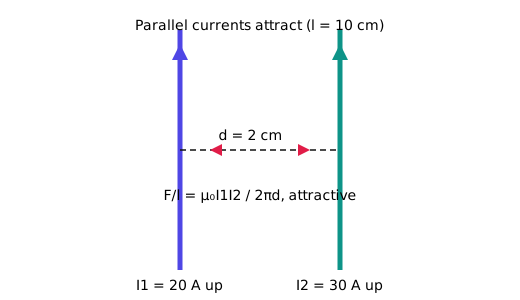
Force between two parallel wires (10 cm long, 2 cm apart, currents 20 A and 30 A).
Recall
Steps
- Combined formula: $F = \mu_0 I_1 I_2\,l/(2\pi d)$ with $\mu_0/2\pi = 2\times 10^{-7}$ (in SI).
- Convert: $l = 0.10$ m, $d = 0.02$ m.
- Substitute: $F = 2\times 10^{-7}\times 20\times 30\times 0.10/0.02$.
- Compute: $20\times 30 = 600$, $0.10/0.02 = 5$, so $F = 2\times 10^{-7}\times 600\times 5 = 6.0\times 10^{-4}$ N.
Answer
Exam tip
B72023
Parallel-plate capacitor ($A = 0.25$ m², $d = 1$ cm, 10 V battery) → force of attraction between plates.
Recall
Steps
- Field of a single sheet: $E_{one} = \sigma/(2\varepsilon_0)$. A plate does not pull on its own field, so the factor is $1/2$.
- Fixed-voltage formula: with $V$ held constant, $F = \varepsilon_0 A V^2/(2 d^2)$.
- Convert: $V = 10$ V, $V^2 = 100$, $d = 0.01$ m, $d^2 = 10^{-4}$ m², $A = 0.25$ m².
- Numerator: $\varepsilon_0 A V^2 = 8.85\times 10^{-12}\times 0.25\times 100 = 2.2125\times 10^{-10}$. Denominator: $2\times 10^{-4}$.
- Ratio: $F = 2.2125\times 10^{-10}/2\times 10^{-4} \approx 1.11\times 10^{-6}$ N.
Answer
Exam tip
Reference. Brij Lal & Subrahmanyam Ch-1, 4, 7; H.C. Verma Vol-1 Ch-29, 31, 34, 35; S.L. Arora Vol-1 Ch-1, 2, 4.