This page covers every inductance numeric in the GE-2 papers (2022, 2019, 2023) plus the two proofs (parallel coils 2022, energy ×2 in 2018 and 2023). Four master formulas solve everything.
Solved PYQs
Q12022
A coil of 800 turns has self-inductance 400 mH. What will be the self-inductance of a similar coil with 500 turns?
Recall
Steps
- Write the ratio: $L_2/L_1 = (N_2/N_1)^2$ (Eq. 2 — "similar coil" means only $N$ changes).
- Substitute $N_2/N_1 = 500/800 = 0.625$.
- Square: $0.625^2 = 0.390625$.
- Multiply: $L_2 = 400 \times 0.390625 = 156.25$ mH.
Answer
Exam tip
Q22019
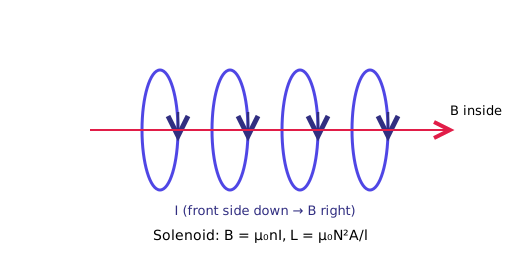
Solenoid 1 m long, 10 cm diameter, 5000 turns: (i) inductance, (ii) energy stored with 2 A current.
Recall
Steps
- Radius and area: $r = 0.05$ m, $A = \pi(0.05)^2 = 7.854\times 10^{-3}$ m² (diameter must be halved first).
- Inductance: $L = (4\pi\times 10^{-7})(5000^2)(7.854\times 10^{-3})/1.0$.
- Compute numerator: $4\pi\times 10^{-7}\times 25\times 10^6 \times 7.854\times 10^{-3} = 0.2467$ H.
- Energy with $I = 2$ A: $U = \tfrac{1}{2}(0.2467)(2^2) = 0.5\times 0.2467 \times 4 = 0.4934$ J.
Answer
Exam tip
Q32023
Find the self-inductance of a solenoid 40 cm long and radius 4 cm having 200 turns ($\mu_r = 1$).
Recall
Steps
- Convert: $l = 0.40$ m, $r = 0.04$ m, $N = 200$. $A = \pi(0.04)^2 = 5.0265\times 10^{-3}$ m².
- Substitute: $L = (4\pi\times 10^{-7})(200^2)(5.0265\times 10^{-3})/0.40$.
- Compute $200^2 = 40\,000$ and the numerator: $4\pi\times 10^{-7}\times 40\,000\times 5.0265\times 10^{-3} = 2.5266\times 10^{-4}$.
- Divide by $0.40$: $L = 6.3166\times 10^{-4}$ H.
Answer
Exam tip
Q42022
Show that the equivalent inductance of two coils $L_1$, $L_2$ in parallel is $(L_1 L_2 − M^2)/(L_1 + L_2 − 2M)$.
Recall
Steps
- Write voltage equations: $V = L_1\,di_1/dt \pm M\,di_2/dt$ and $V = L_2\,di_2/dt \pm M\,di_1/dt$ (each coil sees its own plus mutual e.m.f.).
- Solve the two-equation system for the slopes $di_1/dt$, $di_2/dt$. The determinant is $L_1 L_2 - M^2$.
- Apply Cramer's rule: $di_1/dt = V(L_2 \mp M)/(L_1 L_2 - M^2)$ and $di_2/dt = V(L_1 \mp M)/(L_1 L_2 - M^2)$.
- Add for total: $di/dt = di_1/dt + di_2/dt = V(L_1 + L_2 \mp 2M)/(L_1 L_2 - M^2)$.
- Define $V = L_{eq}\,di/dt$ and read off $L_{eq}$.
- Sanity check: set $M = 0$ and recover $L_{eq} = L_1 L_2/(L_1 + L_2)$ — the resistor-parallel form.
Answer
Exam tip
Q52023
Coils of 50 mH and 100 mH in series give effective inductance 75 mH. Determine the coefficient of mutual inductance.
Recall
Steps
- Compare $L_1 + L_2 = 150$ mH with measured $75$ mH. The measured value is less than the sum, so the minus sign applies (opposing).
- Write the equation: $75 = 150 - 2M$.
- Solve: $2M = 150 - 75 = 75$, so $M = 37.5$ mH.
- Sanity: $M \le \sqrt{L_1 L_2} = \sqrt{50\times 100} = \sqrt{5000} \approx 70.7$ mH, and $37.5 < 70.7$ — physically allowed.
Answer
Exam tip
Q620182023×2
Find the magnetic energy stored in an inductor of self-inductance $L$ carrying current $i$.
Recall
Steps
- Power needed to push current against $e$: $P = e_{applied}\times i = L\,i\,(di/dt)$ (the applied voltage must overcome $L\,di/dt$).
- Small work in time $dt$: $dW = P\,dt = L\,i\,di$.
- Integrate from $0$ to $i$: $W = \int_0^i L\,i\,di = \tfrac{1}{2}Li^2$.
- No heat loss in an ideal coil — all the work sits in the magnetic field.
Answer
Exam tip
Reference. Brij Lal & Subrahmanyam Ch-10; H.C. Verma Vol-1 Ch-38; S.L. Arora Vol-1 Ch-6.