YDSE means Young’s double-slit experiment. One lamp lights two narrow slits. The two beams overlap on a screen and give equal bright and dark stripes. Daily example: two water ripples crossing in a pond.
Here $I_1$, $I_2$ = intensities from slit 1 and slit 2. $\delta$ = phase difference between the two beams. $\lambda$ = wavelength of light. $d$ = slit separation. $D$ = slit-to-screen distance. $y_n$ = position of the $n$-th bright fringe from the centre. $\beta$ = fringe width (one full stripe spacing).
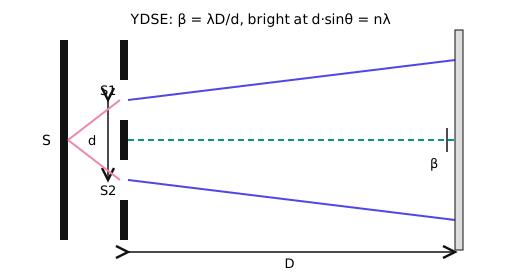
How YDSE works (short derivation)
Step 1 — Coherent waves. At a screen point, the two displacements are $y_1 = a_1\sin\omega t$ and $y_2 = a_2\sin(\omega t + \delta)$. Same $\omega$ and fixed $\delta$ make them coherent.
Step 2 — Add them. By superposition, $y = y_1 + y_2 = A\sin(\omega t + \phi)$ with $A^2 = a_1^2 + a_2^2 + 2a_1 a_2\cos\delta$.
Step 3 — Amplitude → intensity. Light intensity $I \propto A^2$, so with $I_1 \propto a_1^2$, $I_2 \propto a_2^2$ we get Eq. (1): $I = I_1 + I_2 + 2\sqrt{I_1 I_2}\cos\delta$. The $\cos\delta$ term is the interference term — it is missing for incoherent light.
Step 4 — Phase from path. Path difference $\Delta = S_2P - S_1P = d\sin\theta \approx dy/D$ for small angles. Phase $\delta = (2\pi/\lambda)\Delta$.
Step 5 — Bright/dark. Bright (max): $\cos\delta = +1$, so $\delta = 2n\pi$, $\Delta = n\lambda$, positions $y_n = n\lambda D/d$. Dark (min): $\cos\delta = -1$, so $\delta = (2n+1)\pi$, $\Delta = (2n+1)\lambda/2$, positions $y_n’ = (2n+1)\lambda D/2d$.
Step 6 — Fringe width. $\beta = y_{n+1} - y_n = \lambda D/d$. Dark spacing is the same: $y_{n+1}’ - y_n’ = \lambda D/d$. So bright and dark bands have equal width.
Unit check: $[\lambda D/d] = (L \cdot L)/L = L$, correct for $\beta$. Limit: $d \to 0$ gives $\beta \to \infty$ (slits merge, no stripes — sensible).
Plot: $I$ vs $y$ is a $\cos^2$ curve — peaks $I_{max} = I_1+I_2+2\sqrt{I_1I_2}$ (equals $4I_0$ if $I_1 = I_2 = I_0$), valleys $I_{min} = I_1+I_2-2\sqrt{I_1I_2}$ (zero if equal). Draw equal-height peaks, equal spacing $\beta$.
Trap: $\beta$ uses $d$ (slit gap), not slit width. Do not mix them.
Solved PYQs
What is interference of light? State the fundamental conditions for a steady observable interference pattern.
2019Recall
Steps
- Define interference: when two coherent waves overlap, intensity varies point to point — bright and dark fringes appear.
- Condition (i) — coherent sources: same frequency and a constant phase difference, else $\delta$ jumps $\sim 10^8$ times per second and the eye sees only the average $I_1+I_2$.
- Condition (ii) — comparable intensities, else minima stay bright ($I_{min} = (\sqrt{I_1}-\sqrt{I_2})^2$ large) and contrast is poor.
- Condition (iii) — same state of polarization, because perpendicular vibrations do not interfere and intensities just add.
- Condition (iv) — narrow slits close together and (ideally) monochromatic light, because wide or polychromatic sources overlap many patterns and wash fringes out.
Answer
Exam tip
"Two separate sources of light cannot produce interference of light" — explain.
2022Recall
Steps
- Two independent lamps = billions of independent atoms, each emitting in bursts of $\sim 10^{-8}$ s with random starting phase.
- So the phase difference $\delta(t)$ between the lamps changes randomly $\sim 10^8$ times per second — not coherent.
- Eye or screen averages over milliseconds, so $\langle\cos\delta\rangle = 0$ and observed $I = I_1 + I_2$ — uniform light, no fringes.
- Cure: take ONE source and split it — division of wavefront (YDSE, biprism) or division of amplitude (thin films, Newton rings) — so both beams share the same random jumps and $\delta$ stays fixed.
Answer
Exam tip
Young's double slit experiment: coherent waves, resultant intensity pattern, conditions of maxima and minima (both phase and path), and the intensity distribution plot.
2019Recall
Steps
- Take coherent waves $a_1\sin\omega t$ and $a_2\sin(\omega t+\delta)$ — coherence assumed else there is no steady $\delta$.
- Derive $I = I_1+I_2+2\sqrt{I_1I_2}\cos\delta$ using superposition and $I \propto A^2$.
- Maxima: $\cos\delta = +1$, so $\delta = 2n\pi$ (phase) and $\Delta = n\lambda$ (path); $I_{max} = (\sqrt{I_1}+\sqrt{I_2})^2$.
- Minima: $\cos\delta = -1$, so $\delta = (2n+1)\pi$ (phase) and $\Delta = (2n+1)\lambda/2$ (path); $I_{min} = (\sqrt{I_1}-\sqrt{I_2})^2$.
- Plot $I$ vs $y$: a $\cos^2$ curve with equal peaks spaced $\beta = \lambda D/d$, touching zero if $I_1 = I_2$.
Answer
Exam tip
State the conditions for a steady interference pattern. Find the fringe width in YDSE and prove that the dark and bright bands are of equal width.
2024Recall
Steps
- State the 4 steady-pattern conditions briefly: coherence, comparable amplitudes, same polarization, narrow slits (monochromatic).
- Path difference $\Delta = dy/D$ and phase $\delta = 2\pi\Delta/\lambda$ from small-angle geometry.
- Bright positions: $y_n = n\lambda D/d$, so $\beta_{bright} = y_{n+1}-y_n = \lambda D/d$.
- Dark positions: $y_n' = (2n+1)\lambda D/2d$, so $\beta_{dark} = y_{n+1}'-y_n' = \lambda D/d$.
- Hence $\beta_{bright} = \beta_{dark} = \lambda D/d$ — equal width proved.
Answer
Exam tip
What are constructive and destructive interference? Does destructive interference violate the law of conservation of energy?
20222023×2Recall
Steps
- Constructive: waves in step, amplitudes add — $I_{max} = I_1+I_2+2\sqrt{I_1I_2}$ (equals $4I_0$ if $I_1=I_2=I_0$).
- Destructive: waves opposite, amplitudes subtract — $I_{min} = I_1+I_2-2\sqrt{I_1I_2}$ (zero if equal).
- Energy is not destroyed: average intensity over one fringe pair = $I_1 + I_2$ (the $\cos\delta$ term averages to zero).
- So energy is REDISTRIBUTED — taken from dark places and piled onto bright places; total stays $I_1+I_2$ times area.
Answer
Exam tip
In YDSE the slit separation $d = 0.1$ mm, the fringe width $\beta = 5$ mm, and the screen distance $D = 1$ m. Find the wavelength $\lambda$.
2024Recall
Steps
- Convert to metres: $d = 0.1\ \text{mm} = 1.0\times 10^{-4}$ m; $\beta = 5\ \text{mm} = 5.0\times 10^{-3}$ m; $D = 1$ m.
- Formula: from $\beta = \lambda D/d$, rearrange to $\lambda = \beta d/D$.
- Substitute: $\lambda = (5.0\times 10^{-3})(1.0\times 10^{-4})/1 = 5.0\times 10^{-7}$ m.
- Convert for sense: $5.0\times 10^{-7}$ m $= 500$ nm — green light, inside the visible band (400–700 nm).
Answer
Exam tip
In YDSE a glass plate ($\mu_g = 1.5$, thickness $t_g = 12\times 10^{-5}$ mm) is placed over one slit and a diamond plate ($\mu_d = 2.5$) over the other. The central fringe does not shift. Find the thickness of the diamond plate.
2023Recall
Steps
- Glass adds extra path $(\mu_g-1)t_g$ on the slit-1 side; diamond adds $(\mu_d-1)t_d$ on the slit-2 side.
- No shift of central fringe means the two extra paths cancel: $(\mu_g-1)t_g = (\mu_d-1)t_d$.
- Solve for $t_d = (\mu_g-1)t_g/(\mu_d-1) = (1.5-1)(12\times 10^{-5})/(2.5-1)$.
- Arithmetic: numerator $= 0.5 \times 12 \times 10^{-5} = 6 \times 10^{-5}$; divided by $1.5$ gives $t_d = 4 \times 10^{-5}$ mm.
- Sense: diamond bends more ($\mu$ larger), so a thinner piece balances the glass — $4 < 12$, sensible.
Answer
Exam tip
Reference. Brij Lal, Subrahmanyam & Avadhanulu — Optics Ch-13 (coherence), Ch-14 (YDSE, fringe shift, energy); Ajoy Ghatak — Optics Ch-13.