A biprism is two thin prisms joined base to base. One slit shines through it. It bends the light into two beams that look as if they come from two virtual slits — so they interfere. Daily example: one lamp seen twice through a glass edge.
Here $\beta$ = measured fringe width. $d$ = separation of the two virtual sources $S_1$ and $S_2$. $D$ = total distance from source plane to screen (slit→biprism + biprism→screen). $\lambda$ = wavelength.
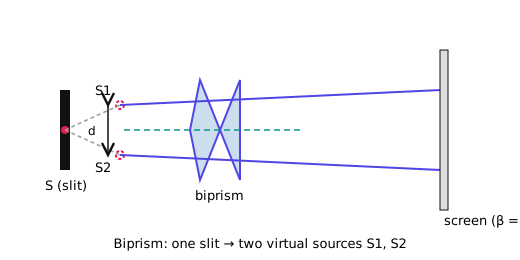
Working and how to measure $\lambda$
Step 1 — Parts. A narrow illuminated slit $S$, a Fresnel biprism (base-to-base prisms of very small angle, $\sim 1^\circ$), and a screen or eyepiece.
Step 2 — Two virtual sources. Light from $S$ passes through the upper half (bent down) and the lower half (bent up). On tracing back, the beams appear to come from two virtual images $S_1$ and $S_2$, symmetric about $S$.
Step 3 — Why coherent. $S_1$ and $S_2$ come from the SAME parent slit $S$, so every random phase jump of $S$ appears in both — the phase difference $\delta$ stays fixed. (Division of wavefront.)
Step 4 — Fringes. The two beams overlap in a central region; path difference $\Delta = dy/D$ gives YDSE-type fringes with $\beta = \lambda D/d$.
Step 5 — Measuring $\lambda$. (i) $\beta$: read $N$ fringes with a micrometer eyepiece, $\beta = \text{total}/N$. (ii) $D$: slit→screen distance on the bench (= slit→biprism + biprism→screen). (iii) $d$: place a convex lens between biprism and screen; two lens positions give image separations $d_1$, $d_2$; then $d = \sqrt{d_1 d_2}$ (displacement method). (iv) Compute $\lambda = \beta d/D$.
Unit check: $[\beta d/D] = (L \cdot L)/L = L$. Limit: $d \to 0$ gives $\beta \to \infty$ (sources merge — sensible).
Trap: $D$ is the FULL slit-to-screen distance, not biprism-to-screen alone.
Solved PYQs
With the help of Fresnel's bi-prism explain how an interference pattern is formed. How is the wavelength of light measured using a biprism?
2023Recall
Steps
- Draw slit $S$ + biprism + screen, and mark the virtual images $S_1$, $S_2$ with dashed rays traced back.
- Explain bending: upper prism bends the beam down, lower prism bends it up; the overlap zone is the interference field.
- Coherence argument: single parent $S$ gives fixed $\delta$, so steady fringes appear with $\beta = \lambda D/d$ (division of wavefront).
- Measurement: $\beta$ by reading $N$ fringes with a micrometer; $D$ on the bench scale; $d = \sqrt{d_1 d_2}$ by the lens displacement method.
- Final: $\lambda = \beta d/D$ reported in nm.
Answer
Exam tip
A biprism is placed $5$ cm from a slit; the virtual images of the slit formed by the biprism are $0.05$ cm apart. The screen is placed $75$ cm from the biprism. Given $\lambda = 5.89\times 10^{-5}$ cm, find the fringe width.
2022Recall
Steps
- Given: slit→biprism $= 5$ cm; biprism→screen $= 75$ cm; $d = 0.05$ cm; $\lambda = 5.89 \times 10^{-5}$ cm.
- Total distance: $D = 5 + 75 = 80$ cm — $D$ is source-plane to screen-plane, i.e. slit to screen.
- Formula: $\beta = \lambda D/d$ — same as YDSE; the biprism only changes how $S_1$ and $S_2$ are made.
- Substitute: $\beta = (5.89 \times 10^{-5} \times 80)/0.05 = (5.89 \times 10^{-5}) \times 1600 = 9.424 \times 10^{-2}$ cm.
- Sense: $\beta \approx 0.094$ cm $\approx 0.94$ mm — about 10 fringes per cm, easily seen in an eyepiece.
Answer
Exam tip
Reference. Brij Lal, Subrahmanyam & Avadhanulu — Optics Ch-14 (biprism, displacement method); Ajoy Ghatak — Optics Ch-13.