Two light waves meet. Where crest meets crest it is bright. Where crest meets trough it is dark. This is interference. Daily example: colours on a soap bubble and on an oil film on wet road.
Steady interference needs coherent waves. Coherent means same frequency and a constant phase difference. One source is split into two. Two separate lamps cannot give a steady pattern.
This page is a hub. Full theory and solved PYQs live in the three subpages below. Total 12 PYQs (2019–2024).
The 3 subpages (read in this order)
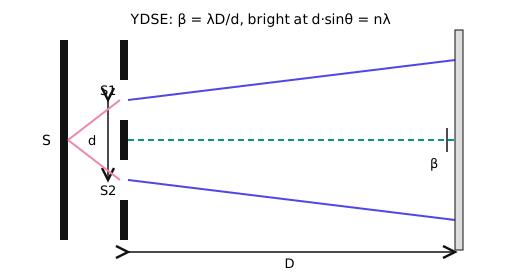
1. YDSE, coherence, energy, fringe shift → Interference — YDSE
Coherence conditions (2019). Why two separate sources fail (2022). Full YDSE intensity $I = I_1 + I_2 + 2\sqrt{I_1 I_2}\cos\delta$, bright and dark conditions, fringe width $\beta = \lambda D/d$, equal-width proof (2024). Energy-conservation question (×2: 2022, 2023). Two numerics: $\lambda$ from fringe width (2024) and glass-vs-diamond thickness (2023).
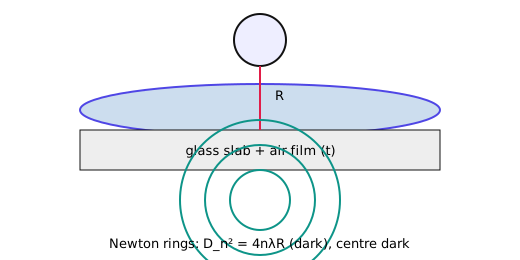
2. Newton rings → Interference — Newton Rings
Characteristics list (2024). Formation with air film and the Stokes $\lambda/2$ step, geometry $t = r^2/2R$, derivation $D_n^2 = 4n\lambda R$ for dark rings (bright shifted by half order). Rings numeric 2019 with full arithmetic ($\lambda \approx 546$ nm).
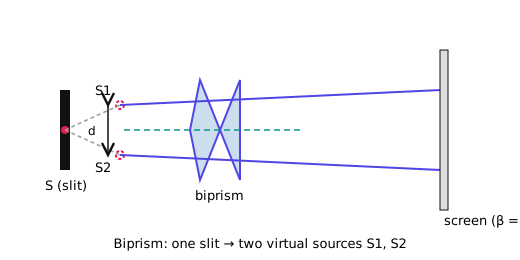
3. Fresnel biprism → Interference — Biprism
Working (two virtual coherent sources from one slit) and how $\lambda$ is measured with it (2023). Fringe-width numeric 2022 ($\beta \approx 0.094$ cm, with $D = 5 + 75 = 80$ cm shown).
Most-repeated Interference questions
Quick map of all 12 PYQs. Full solutions live in the subpages.
| Subtopic | PYQ topic | Year(s) | ×n |
|---|---|---|---|
| YDSE | Conditions for steady pattern | 2019 | ×1 |
| YDSE | Why two separate sources fail | 2022 | ×1 |
| YDSE | YDSE full derivation + plot | 2019 | ×1 |
| YDSE | Fringe width + equal-width proof | 2024 | ×1 |
| YDSE | Energy conservation in interference | 2022, 2023 | ×2 |
| YDSE | YDSE numeric ($\lambda$ from $\beta$) | 2024 | ×1 |
| YDSE | Glass–diamond thickness | 2023 | ×1 |
| Newton rings | Characteristics | 2024 | ×1 |
| Newton rings | Formation + $D_n^2$ derivation | 2019, 2022 | ×2 |
| Newton rings | Rings numeric ($\lambda$ from $R$, $D_m$, $D_n$) | 2019 | ×1 |
| Biprism | Working + $\lambda$ measurement | 2023 | ×1 |
| Biprism | Biprism numeric ($\beta$ from $d$, $D$, $\lambda$) | 2022 | ×1 |
Exam tip: if the question says “steady pattern”, first line must be coherence. If it gives fringe width, first line must be $\beta = \lambda D/d$. If rings, first line must be Stokes $\lambda/2$ and centre dark.
Reference. Brij Lal, Subrahmanyam & Avadhanulu — Optics Ch-13, 14, 15; Ajoy Ghatak — Optics Ch-13.