This page covers the wave side of Maxwell’s theory. It has three short theory sections, one figure, and four solved PYQs.
1. Poynting vector + energy density
An EM wave carries energy. The Poynting vector $\vec{S}$ tells how much power flows per unit area and in which direction. Like water flow: amount per second through each square metre, pointing downstream.
Symbols: $\vec{E}$ electric field (V/m), $\vec{B}$ magnetic field (T), $\vec{H} = \vec{B}/\mu_0$ in vacuum (A/m), $\mu_0 = 4\pi\times 10^{-7}$ H/m.
Energy density
Energy stored per unit volume: electric part $u_E = \tfrac{1}{2}\varepsilon_0 E^2$, magnetic part $u_B = B^2/(2\mu_0)$. For a plane wave $E = cB$, the two halves are equal, total $u = \varepsilon_0 E^2 = B^2/\mu_0$. Then $S = uc$ (energy density $u$ moving at speed $c$ gives flux $uc$).
Unit check
$[E\times B/\mu_0] = (\text{V/m·T})/(\text{N/A}^2) = \text{W/m}^2$, power per area. Correct.
2. Speed and wavelength in a medium
Light slows down inside glass or water. Refractive index $n$ tells by what factor.
Worked divisions
Water $n = 1.33$: $1.33\times 2.25 = 2.9925 \approx 3.00$, so $v \approx 2.26\times 10^8$ m/s.
Glass $n = 1.658$, $\lambda_0 = 5893$ Å: $1.658\times 3554 = 5892.57 \approx 5893$, so $\lambda \approx 3554$ Å.
Glass speed: $1.658\times 1.81 = 3.00098 \approx 3.00$, so $v \approx 1.81\times 10^8$ m/s.
3. Properties of EM waves + how to verify a given field pair
Six properties: transverse, speed $c$, ratio $E/B = c$, carries energy and momentum, needs no medium, obeys reflection/refraction/interference/diffraction/polarization.
4-point verification test
For a given $\vec{E}$, $\vec{B}$ pair, check:
- $\vec{E}\cdot\vec{B} = 0$ (perpendicular).
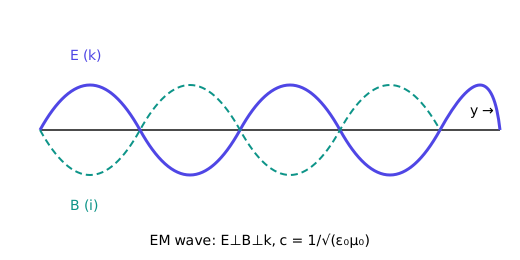
- Find propagation direction from phase $(ky - \omega t)$ — wave travels along $+y$ (constant phase $y = (\omega t + \text{const})/k$ grows with $t$).
- $E_0/B_0 = \omega/k = c$ (amplitude ratio).
- Faraday $\nabla\times\vec{E} = -\partial\vec{B}/\partial t$ holds component-wise.
Reference. Brij Lal & Subrahmanyam Ch-11 (Poynting, energy density); Ajoy Ghatak Ch-7 (wave properties).
Solved PYQs
Define Poynting vector (and its unit).
201820192022×3 Recall- Write $\vec{S} = (\vec{E}\times\vec{B})/\mu_0 = \vec{E}\times\vec{H}$ (reason: energy flux of the fields).
- Direction = propagation direction by right-hand rule (reason: cross product gives a perpendicular vector).
- Unit derivation: $(\text{V/m})\times\text{T}\,\div\,(\text{N/A}^2) = \text{W/m}^2$ (reason: SI base unit check).
Refractive index & velocity of light in a medium: velocity/wavelength in water ($n = 1.33$) and glass ($n = 1.658$) for $\lambda = 5893$ Å.
202220232024×3 Recall- Water: $v = 3.00\times 10^8/1.33 = 2.26\times 10^8$ m/s (reason: $1.33\times 2.25 = 2.9925 \approx 3.00$).
- Glass wavelength: $\lambda = 5893/1.658 = 3554.3$ Å (reason: $1.658\times 3554 = 5892.57 \approx 5893$).
- Glass speed: $v = 3.00\times 10^8/1.658 = 1.81\times 10^8$ m/s (reason: $1.658\times 1.81 = 3.00098 \approx 3.00$).
- Convert if needed: $3554$ Å $= 3.554\times 10^{-7}$ m.
Write down the main properties of electromagnetic waves.
2023 Recall- Transverse: $\vec{E}\perp\vec{B}$, both perpendicular to propagation (reason: from curl equations).
- Speed $c = 1/\sqrt{\mu_0\varepsilon_0}$ in vacuum, $v = c/n$ in a medium (reason: wave equation).
- Amplitude ratio $E/B = c$ (reason: substitute plane wave into Maxwell equations).
- Carries energy (Poynting vector $\vec{S}$) and momentum (radiation pressure $p = u$ on absorption) (reason: from energy density argument).
- Needs no medium — travels through vacuum (reason: derived from Maxwell equations alone).
- Shows reflection, refraction, interference, diffraction, polarization (reason: light is an EM wave).
Show that $\vec{E} = E_0\cos(ky-\omega t)\,\hat{k}$ and $\vec{B} = B_0\cos(ky-\omega t)\,\hat{\imath}$ represent an electromagnetic field.
2023 Recall- $\vec{E}\cdot\vec{B} = E_0B_0\cos^2(ky-\omega t)(\hat{k}\cdot\hat{\imath}) = 0$ (reason: $\hat{k}\cdot\hat{\imath} = 0$, fields perpendicular).
- Phase $(ky-\omega t)$: constant phase gives $y = (\omega t + \text{const})/k$, which grows with $t$, so propagation is $+y$ (reason: phase-front moves to larger $y$); also $\vec{S} \propto \hat{k}\times\hat{\imath} = \hat{\jmath}$ confirms $+y$.
- Require $E_0/B_0 = \omega/k = c$ (reason: amplitude ratio for a vacuum wave).
- Faraday check: $\nabla\times\vec{E} = -E_0k\sin(ky-\omega t)\,\hat{\imath}$ (reason: only $E_z$ varies, only with $y$), and $-\partial\vec{B}/\partial t = -B_0\omega\sin(ky-\omega t)\,\hat{\imath}$; equality needs $E_0k = B_0\omega$, i.e. $E_0/B_0 = \omega/k$. Same check works for Ampere–Maxwell.
Reference. Brij Lal & Subrahmanyam Ch-11 (Poynting, energy density); Ajoy Ghatak Ch-7 (wave properties).