This page covers superposition of two perpendicular SHMs. It has four short theory sections, one figure, and two solved PYQs.
1. What are Lissajous figures? Formation
Shake a light spot left-right and up-down at the same time. The spot draws a looping pattern on the screen. That pattern is a Lissajous figure. Its shape tells the frequency ratio and phase gap of the two shakes.
For $x = a\sin(\omega_1 t+\phi)$, $y = b\sin(\omega_2 t)$, the spot $(x,y)$ traces a curve fixed by ratio $\omega_1:\omega_2$ and phase $\phi$.
Graphical method
Plot $x(t)$ and $y(t)$ sine strips on the top and side of a square. At each instant $t$, drop a line from the $x$-strip and run a line from the $y$-strip; their crossing point is the spot. Join the crossings over one full period. Changing $\phi$ slides the side strip and morphs the figure.
Uses
- Measure unknown frequency: feed known $f$ to one axis, unknown to the other, read the ratio from the figure.
- Measure phase gap between two signals.
- Calibrate a CRO (check amplifiers and time base).
- Study vibrations (turntable wobble, tuning-fork comparison).
2. Analytical method: 1:1 case
Remove time $t$ from the two equations. For equal frequencies the path is always an ellipse; phase picks circle or line.
For $x = a\sin(\omega t+\phi)$, $y = b\sin\omega t$, expand $x/a = \sin\omega t\cos\phi + \cos\omega t\sin\phi$, use $\sin^2+\cos^2 = 1$ and square to kill the root:
Phase table (1:1)
- $\phi = 0$: $(x/a - y/b)^2 = 0$, so $y = (b/a)x$ — straight line through origin.
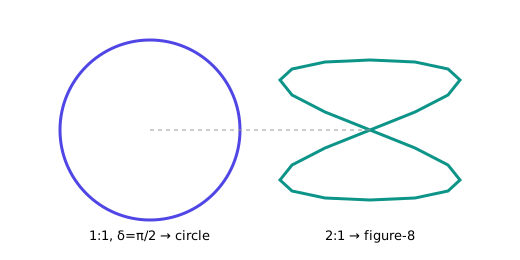
- $\phi = \pi/2$, equal $a$: $x^2+y^2 = a^2$ — circle.
- $\phi = \pi$: line $y = -(b/a)x$ — other diagonal.
3. Frequency ratio by tangency method
Count touches on the bounding box. $N_x$ = touches on a vertical side, $N_y$ = touches on a horizontal side.
Worked example: figure-8 lying sideways ($\infty$). Left wall touched once ($N_x = 1$), top wall touched twice ($N_y = 2$). Ratio $f_x:f_y = 2:1$. So if the $y$-plates get $50$ Hz, the $x$-plates get $100$ Hz.
4. Electrical demonstration (CRO)
Wiring: Generator 1 → CRO X-input (horizontal plates). Generator 2 → CRO Y-input (vertical plates). Set CRO to X-Y mode (no internal time base; the spot position is directly $(V_x, V_y)$). Common ground all three chassis. Start near $50$ Hz with equal gains. Adjust one generator until the figure stands still — drifting figure means frequencies not in exact ratio.
Solved PYQs
What are Lissajous figures? (two practical applications / demonstration by electrical experiment)
20232024×2 Recall- Define: the path of $(a\sin(\omega_1 t+\phi), b\sin\omega_2 t)$ from perpendicular SHM superposition (reason: each instant gives one spot).
- Shape fixed by frequency ratio + phase (reason: Eqs. 1–2 above).
- Application 1: unknown-frequency measurement by tangency ratio $f_x/f_y = N_y/N_x$ (reason: count box-touches).
- Application 2: phase measurement or CRO calibration using a still figure (reason: shape encodes phase).
- CRO wiring: two signal generators → X-input and Y-input, CRO in X-Y mode, common ground, still figure means locked ratio (reason: no time base; spot is $(V_x, V_y)$).
Two SHMs of same frequency and amplitude, phase difference $\pi/2$, in perpendicular directions. What is the shape of the resultant motion?
2023 Recall- $y = a\sin(\omega t+\pi/2) = a\cos\omega t$ (reason: $\sin(x+\pi/2) = \cos x$).
- $x = a\sin\omega t$ gives $\sin\omega t = x/a$; $y = a\cos\omega t$ gives $\cos\omega t = y/a$.
- Square and add: $x^2/a^2 + y^2/a^2 = \sin^2\omega t + \cos^2\omega t = 1$ (reason: identity $\sin^2 + \cos^2 = 1$ kills $t$).
- Multiply by $a^2$: $x^2 + y^2 = a^2$.
Reference. Subrahmanyam & Brij Lal — Waves & Oscillations Ch-5 (graphical and analytical methods, uses).