This page is about electric potential and the electric dipole. We start with the dipole moment vector, then derive the dipole potential $V(r,\theta)$ and its field. After that we solve three short 2019 gradient problems (Q20, Q21, Q22) and prove that the electrostatic field is conservative.
1. Electric dipole and dipole moment
A dipole is a pair of equal and opposite charges $+q$ and $-q$ separated by a small distance $2l$. Daily example: an HCl molecule. The dipole moment vector is defined as
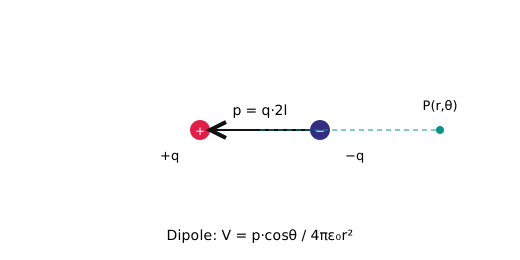
2. Potential and field of a dipole
Electric potential is work per unit positive test charge to bring it from infinity to the point. For a point charge, $V = q/4\pi\varepsilon_0 r$. For a dipole at field point $(r,\theta)$ with $r \gg l$:
2.1 Derivation of $V(r,\theta)$
The point $P$ is far away, so $r \gg l$. The distances from $P$ to $+q$ and $-q$ differ only by the projection of $2l$ on the line to $P$.
- Approximate distances: $r_1 \approx r - l\cos\theta$ (to $+q$) and $r_2 \approx r + l\cos\theta$ (to $-q$) — reason: projection of half-separation $l$ on $\hat{r}$.
- Total potential (principle of superposition): $V = \dfrac{q}{4\pi\varepsilon_0}\left(\dfrac{1}{r_1} - \dfrac{1}{r_2}\right)$.
- Combine the fractions: $\dfrac{1}{r_1} - \dfrac{1}{r_2} = \dfrac{r_2 - r_1}{r_1 r_2} \approx \dfrac{2l\cos\theta}{r^2}$ — reason: $r_1 r_2 \approx r^2$ when $r \gg l$.
- Insert $p = q\cdot 2l$: $V = \dfrac{p\cos\theta}{4\pi\varepsilon_0 r^2}$ (Eq. 2). Limit: $V \to 0$ as $r \to \infty$. ✓
2.2 Field from potential
From $\vec{E} = -\nabla V$ in spherical coordinates, the radial and angular components are $E_r = -\partial V/\partial r$ and $E_\theta = -(1/r)\partial V/\partial\theta$.
- $\partial V/\partial r = -\dfrac{2p\cos\theta}{4\pi\varepsilon_0 r^3}$, so $E_r = +\dfrac{2p\cos\theta}{4\pi\varepsilon_0 r^3}$ (reason: minus times minus).
- $\partial V/\partial\theta = -\dfrac{p\sin\theta}{4\pi\varepsilon_0 r^2}$, so $E_\theta = +\dfrac{p\sin\theta}{4\pi\varepsilon_0 r^3}$ (reason: same).
- Special cases — on the axis ($\theta = 0$): $E = 2p/4\pi\varepsilon_0 r^3$; on the equator ($\theta = 90°$): $E = p/4\pi\varepsilon_0 r^3$ (opposite to $\vec{p}$).
Solved PYQs
What is an electric dipole? Define electric dipole moment.
×220182019Recall
Steps
- Define the dipole: two equal and opposite charges $\pm q$ separated by a small distance $2l$.
- Define the dipole moment $\vec{p} = q\cdot 2\vec{l}$ — a vector pointing from $-q$ toward $+q$.
- State the unit (C·m) and give one daily-life example (HCl, H₂O).
Answer
Exam tip
Deduce the electric potential (and field) at any point $(r,\theta)$ due to an electric dipole.
×220182022Recall
Steps
- Write $V = \dfrac{q}{4\pi\varepsilon_0}\left(\dfrac{1}{r_1} - \dfrac{1}{r_2}\right)$ with $r_1 \approx r - l\cos\theta$, $r_2 \approx r + l\cos\theta$.
- Combine: $\dfrac{1}{r_1} - \dfrac{1}{r_2} = \dfrac{2l\cos\theta}{r_1 r_2} \approx \dfrac{2l\cos\theta}{r^2}$ (reason: $r_1 r_2 \approx r^2$ for $r \gg l$).
- Insert $p = 2ql$: $V = \dfrac{p\cos\theta}{4\pi\varepsilon_0 r^2}$ — Eq. (2) first part.
- Differentiate: $E_r = -\partial V/\partial r = \dfrac{2p\cos\theta}{4\pi\varepsilon_0 r^3}$ and $E_\theta = -(1/r)\partial V/\partial\theta = \dfrac{p\sin\theta}{4\pi\varepsilon_0 r^3}$ — Eq. (2) rest.
Answer
Exam tip
Potential $V(x,y,z) = -k(x^2+y^2+z^2)$, $k$ a constant. Find $\vec{E}$ at $(1,1,1)$.
2019Recall
Steps
- Differentiate: $\partial V/\partial x = -2kx$, $\partial V/\partial y = -2ky$, $\partial V/\partial z = -2kz$ (reason: power rule, other variables held constant).
- Apply the minus sign of $-\nabla V$: $\vec{E} = 2k\,(x\hat{i} + y\hat{j} + z\hat{k})$.
- Insert $(x,y,z) = (1,1,1)$: $\vec{E} = 2k\,(\hat{i} + \hat{j} + \hat{k})$, magnitude $|E| = 2k\sqrt{3}$.
Answer
Exam tip
Find $\nabla\phi$ where $\phi = 1/r$.
2019Recall
Steps
- Differentiate the $x$-component: $\dfrac{\partial}{\partial x}\!\left(\dfrac{1}{r}\right) = -\dfrac{1}{r^2}\dfrac{\partial r}{\partial x} = -\dfrac{x}{r^3}$ (reason: chain rule).
- By symmetry, the $y$- and $z$-components are $-y/r^3$ and $-z/r^3$.
- Combine: $\nabla(1/r) = -\dfrac{x\hat{i}+y\hat{j}+z\hat{k}}{r^3} = -\dfrac{\vec{r}}{r^3} = -\dfrac{\hat{r}}{r^2}$.
- Therefore the field of a point charge $Q$ is $\vec{E} = -\dfrac{Q}{4\pi\varepsilon_0}\nabla(1/r) = \dfrac{Q}{4\pi\varepsilon_0 r^2}\hat{r}$.
Answer
Exam tip
Find the potential at $(x,y,z)$ for the conservative field $\vec{F} = (2xy+z^2)\hat{i} + x^2\hat{j} + 2xz\hat{k}$.
2019Recall
Steps
- Check it is conservative: $\partial_y F_z - \partial_z F_y = 0 - 0 = 0$, $\partial_z F_x - \partial_x F_z = 2z - 2z = 0$, $\partial_x F_y - \partial_y F_x = 2x - 2x = 0$. So $\nabla\times\vec{F} = 0$ — a potential $V$ exists.
- Integrate $F_x$: $V = -\int (2xy+z^2)\,dx = -(x^2 y + x z^2) + f(y,z)$ (reason: integral of $2xy$ is $x^2 y$, of $z^2$ is $xz^2$; $y$ and $z$ are constants under $x$-integration).
- Match $F_y$: $-\partial V/\partial y = x^2 - \partial_y f$ must equal $F_y = x^2$, so $\partial_y f = 0$.
- Match $F_z$: $-\partial V/\partial z = 2xz - \partial_z f$ must equal $F_z = 2xz$, so $\partial_z f = 0$.
- Hence $f = $ constant $C$. Final: $V(x,y,z) = -(x^2 y + x z^2) + C$.
Answer
Exam tip
Prove that the electrostatic field is conservative.
2019Recall
Steps
- Coulomb force on a test charge $q_0$ at distance $r$ from $Q$ is $\vec{F} = \dfrac{Q q_0}{4\pi\varepsilon_0 r^2}\hat{r}$ — central and $\propto 1/r^2$ (reason: depends only on the distance $r$, no angular part).
- Work moving $q_0$ from A to B along any path: $W_{AB} = \int_A^B \vec{F}\cdot d\vec{l} = \dfrac{Q q_0}{4\pi\varepsilon_0}\!\int_{r_A}^{r_B}\!\dfrac{dr}{r^2} = \dfrac{Q q_0}{4\pi\varepsilon_0}\!\left(\dfrac{1}{r_A} - \dfrac{1}{r_B}\right)$. The answer depends only on $r_A$ and $r_B$, not the path.
- Round trip A → B → A: $W = W_{AB} + W_{BA} = 0$. So $\oint \vec{E}\cdot d\vec{l} = 0$ for any closed loop.
- By Stokes' theorem, $\oint \vec{E}\cdot d\vec{l} = \int (\nabla\times\vec{E})\cdot d\vec{S} = 0$ for every surface, so $\nabla\times\vec{E} = 0$. A scalar potential exists with $\vec{E} = -\nabla V$.
Answer
Exam tip
Reference. Brij Lal & Subrahmanyam, Electricity & Magnetism Ch-1 (dipole, potential, conservative field); S.L. Arora Vol-1 Ch-1.