Light bends round small obstacles and spreads after a narrow opening. This bending and spreading is diffraction. Daily example: sound heard round a corner; light fringes at a razor edge. Interference is few waves; diffraction is many tiny waves adding up.
The one idea behind everything below: Fresnel half-period zones. Take a wavefront and cut it into rings so that each next ring is $\lambda/2$ farther from the screen point. Neighbour rings arrive out of phase and nearly cancel; the first zone dominates. Blocking alternate zones (zone plate) or adding many slits (grating) controls this sum.
Here $r_n$ = radius of the $n$-th zone boundary. $b$ = plate-to-screen (image) distance for a plane wave from infinity. $f$ = first (primary) focal length. $r_1$ = first zone radius. $(a+b)$ = grating element (one slit width $a$ + one opaque gap $b$ = grating period). $N = 1/(a+b)$ = lines per unit length. $\theta_n$ = angle of the $n$-th principal maximum. $n = 0, \pm1, \pm2\ldots$ = order.
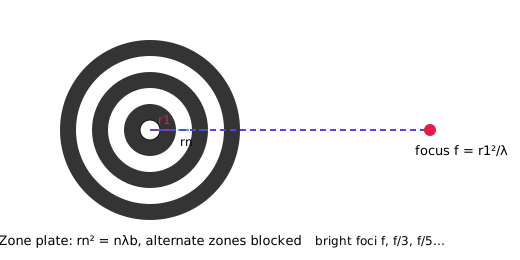
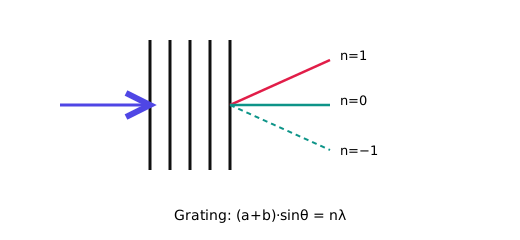
Zone plate — construction, foci, vs convex lens
Construction (exam steps). (i) Compute $r_n = \sqrt{n\lambda b}$ for chosen $\lambda$ and $b$. (ii) Draw concentric circles of radii $r_n$ on paper. (iii) Blacken alternate rings (all odd or all even). (iv) Photograph it reduced to get a fine plate.
Why it focuses. Open zones differ by $2\times\lambda/2 = \lambda$ in path, so they all arrive in phase at $f$ — bright spot. Other points give extra foci at $f/3$, $f/5$, … (odd fractions) where the phase still lines up.
Zone plate vs convex lens (memorise the table):
| Point | Zone plate | Convex lens |
|---|---|---|
| Works by | diffraction (blocking zones) | refraction (glass bending) |
| Foci | many: $f$, $f/3$, $f/5$, … | one (nearly) |
| Colour | highly chromatic ($f \propto 1/\lambda$) | nearly achromatic |
| Brightness | dimmer (half the light blocked) | bright (all light through) |
| Image | diffracted orders + background | single clean image |
Trap: longer wavelength gives SHORTER focal length ($f = r_1^2/\lambda$), so red focuses nearer than violet, opposite of a glass lens.
Plane grating — element and spectrometer method
Spectrometer method (exam steps). (i) Collimator gives a parallel beam on the grating at normal incidence. (ii) Turn the telescope to order $n$ on the left, read angle; repeat on the right; half the difference = $\theta_n$. (iii) With known $(a+b) = 1/N$, compute $\lambda = (a+b)\sin\theta_n/n$. Use several orders and average.
Highest order: $|\sin\theta_n| \le 1$ gives $n_{max} < (a+b)/\lambda$ — take the integer below the ratio.
Solved PYQs
What is a zone plate? Explain its construction. Compare it with a convex lens.
20192024×2Recall
Steps
- Definition: a plate of concentric rings, alternate zones transparent/opaque, which focuses light by diffraction.
- Zone radii: the "next ring $\lambda/2$ farther" condition gives $r_n^2 = n\lambda b + n^2\lambda^2/4 \approx n\lambda b$ since $\lambda \ll b$.
- Construction: compute, draw, blacken alternate, photo-reduce (4 steps above).
- Focus: open zones agree in phase → bright image at $f = r_1^2/\lambda$, plus $f/3$, $f/5$, … (odd fractions).
- Table: diffraction vs refraction, many foci vs one, chromatic vs achromatic, dimmer vs brighter (5 rows).
Answer
Exam tip
What is a plane diffraction grating? Define grating element (grating constant). Describe the method of determining the wavelength of monochromatic light using a grating and a spectrometer.
2023Recall
Steps
- Define grating: many parallel equal slits, $N$ lines/cm, so the grating element is $(a+b) = 1/N$.
- Quote the grating equation $(a+b)\sin\theta_n = n\lambda$ — neighbouring slits differ by $(a+b)\sin\theta_n$, in-phase when $= n\lambda$.
- Spectrometer: collimator → normal incidence on grating; telescope reads $\theta_n$ on the left and on the right; $\theta_n$ = half the difference.
- Compute $\lambda = (a+b)\sin\theta_n/n$ for orders $n = 1, 2$ and average; higher $n$ spreads more, so precision is better.
- Validity: normal incidence, monochromatic source, grating plane vertical.
Answer
Exam tip
Find the highest order of the spectrum with sodium light, given (i) $\lambda = 5.89\times 10^{-5}$ cm and $3000$ lines/cm (2022); (ii) $\lambda = 5896$ Å and $2000$ lines/cm (2023).
20222023×2Recall
Steps (2022)
- Element: $(a+b) = 1/3000$ cm $= 3.333 \times 10^{-4}$ cm.
- Ratio: $(a+b)/\lambda = 3.333 \times 10^{-4}/5.89 \times 10^{-5} = 33.33/5.89 = 5.658$.
- Integer below: $n_{max} = 5$ — order $6$ would need $\sin\theta > 1$.
Steps (2023)
- Convert: $\lambda = 5896$ Å $= 5896 \times 10^{-8}$ cm $= 5.896 \times 10^{-5}$ cm; element $(a+b) = 1/2000 = 5.0 \times 10^{-4}$ cm.
- Ratio: $5.0 \times 10^{-4}/5.896 \times 10^{-5} = 50.0/5.896 = 8.480$.
- Integer below: $n_{max} = 8$ — 9th order cannot emerge.
Answer
Exam tip
In a plane transmission grating the wavelength of light is $500$ nm and the second-order principal maximum is obtained at $30^\circ$. Find the number of lines per cm on the grating.
2019Recall
Steps
- Given: $\lambda = 500$ nm, $n = 2$, $\theta_2 = 30^\circ$, $\sin 30^\circ = 0.5$.
- Element: $(a+b) = n\lambda/\sin\theta = 2 \times 500/0.5 = 2000$ nm.
- Convert: $2000$ nm $= 2000 \times 10^{-7}$ cm $= 2.0 \times 10^{-4}$ cm.
- Lines: $N = 1/(2.0 \times 10^{-4}) = 5000$ per cm.
- Sense: $5000$/cm is a standard coarse grating — fine gratings run $\sim 15000$/cm.
Answer
Exam tip
Reference. Brij Lal, Subrahmanyam & Avadhanulu — Optics Ch-16 (Fresnel zones, zone plate), Ch-17 (grating, spectrometer); Ajoy Ghatak — Optics Ch-15, 16.