Light is a transverse wave. Its electric field E always vibrates at right angles to the travel direction. If the vibration keeps changing direction, the light is unpolarized. If it vibrates in one fixed pattern, the light is polarized. Ordinary sunlight is unpolarized; the light reflected from a wet road or passed through a Polaroid sunglass is polarized — that is why glare drops. The six solved PYQs below cover the full syllabus (×2 2018,2023 · ×2 2022,2024 · 2023 · ×2 2022,2024 · 2019).
1. Polarized vs unpolarized light + Nicol prism test
Unpolarized light has E vibrating in every direction perpendicular to the ray, with no fixed phase relation. Polarized light comes in three types: (i) plane (linear) — E stays in one plane; (ii) circularly polarized — tip of E draws a circle (two equal perpendicular components with 90° phase difference); (iii) elliptically polarized — tip draws an ellipse (unequal components, or phase not exactly 90°).
A Nicol prism passes only vibrations parallel to its principal section and blocks the rest. So rotate a Nicol around the beam and watch the output: (i) plane-polarized input — intensity falls to zero twice per full rotation (extinction positions); (ii) unpolarized input — intensity stays constant (every direction is equally present); (iii) partially polarized input — intensity varies but never reaches zero.
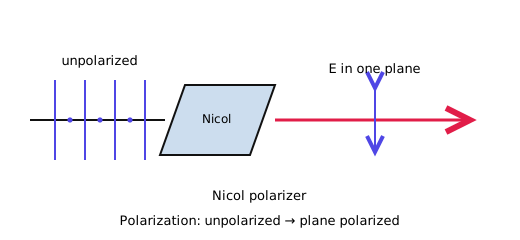
What is the difference between polarised and unpolarised light? How do you test it? 2018 2023 ×2
Recall
Steps
- State the vibration picture — ordinary (unpolarized) light has E vectors pointing in every direction normal to the ray [this is the definition, draw arrows plus dots].
- State plane-polarized light — all E vibrations lie in one plane containing the ray [one direction only, draw a single double-arrow].
- Add circular and elliptic in one line each — equal amplitudes + 90° gives a circle, unequal amplitudes give an ellipse [this shows the full family].
- Give the Nicol test — pass the beam through a Nicol and rotate it about the beam axis [because the Nicol transmits only the component along its principal section].
- Read the result — intensity zero twice per rotation means plane polarized, constant intensity means unpolarized [because rotating the pass-direction samples every vibration direction].
Answer
Exam tip
2. Double refraction — o-ray, e-ray and the crystals
Most crystals bend light once. Some crystals — calcite, quartz, tourmaline — split one incoming ray into two refracted rays inside the crystal. This is double refraction (birefringence). Daily example: put a calcite crystal on a printed letter and you see every letter doubled.
The o-ray has a fixed index μo and speed vo = c/μo in every direction, so it obeys Snell law. The e-ray has an index that varies with direction between μo and μe, so it may not obey Snell law and may leave the plane of incidence. The optic axis is the special direction along which both rays travel with the same speed, so no splitting is seen down that direction. Double-refracting crystals to remember: calcite (strong splitter, negative: μe < μo), quartz (weak splitter, positive: μe > μo), tourmaline (absorbs the o-ray, so the transmitted beam is plane polarized — used in tourmaline tongs).
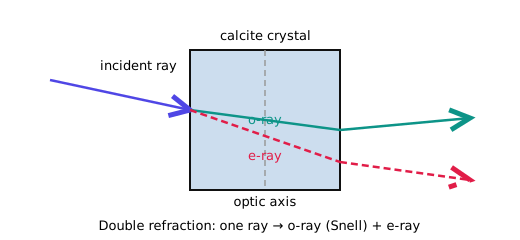
What is meant by double refraction of light? Name a double refracting crystal. 2022 2024 ×2
Recall
Steps
- Define double refraction — when unpolarized light enters certain crystals, it divides into two refracted rays, the ordinary and the extraordinary ray.
- Contrast the two rays — the o-ray has constant speed vo = c/μo and obeys Snell law, the e-ray has direction-dependent speed and in general disobeys Snell law [because the crystal responds differently to E along different axes].
- Name two crystals with one word each — calcite (wide splitting), quartz, tourmaline [the paper asks to "name" — two is the minimum].
- Add the optic-axis line — along the optic axis both rays travel with equal speed, so no doubling is seen down that direction [symmetry makes both indices equal there].
Answer
Exam tip
3. Huygens theory of double refraction (sphere + spheroid)
Huygens said every point of a wavefront is a fresh source of secondary wavelets, and the new wavefront is the tangent envelope of all wavelets. Inside a doubly refracting crystal each source sends out two wavelets: a sphere for the o-ray and a spheroid (ellipsoid of revolution about the optic axis) for the e-ray. The two tangent envelopes give two refracted fronts — hence two rays.
Construction (tangent-envelope steps, draw as you write):
- Let a plane wavefront strike the crystal surface; pick several point sources on the surface inside the crystal [each surface point re-radiates].
- About each source draw the o-wavelet — a sphere of radius vo·t [the o-ray speed is direction-independent].
- About the same sources draw the e-wavelet — a spheroid of revolution about the optic axis, touching the sphere along the axis (polar radius vo·t, equatorial radius ve·t) [along the axis both speeds are equal, across it they differ].
- Draw the common tangent plane to all spheres — that is the o-refracted front; draw the common tangent plane to all spheroids — that is the e-refracted front [Huygens envelope rule applied twice].
- Join the sources to the touch points to get the o-ray and e-ray directions; the o-ray obeys Snell law, the e-ray in general does not [the ray is the line from source to envelope contact].
Write Huygens' theory of double refraction. 2023
Recall
Steps
- State Huygens principle — every wavefront point is a secondary source, and the forward tangent envelope is the new front [this is the foundation of the construction].
- Inside the crystal each point emits two wavelets — a spherical o-wavelet (radius vo·t) and a spheroidal e-wavelet (axis = optic axis) [direction-independent vs direction-dependent speed].
- Draw 3–4 sources on the crystal surface with both wavelets, touching on the optic axis [the diagram mark — spheres inside or outside per crystal type].
- Draw the two common tangents — tangent to spheres = o-front, tangent to spheroids = e-front [envelope rule applied twice].
- Read off the rays (source → contact point) and conclude — two refracted rays, o-ray obeying Snell law, e-ray generally not [this is the observed double refraction].
Answer
Exam tip
4. Quarter-wave plate — formula t = λ / 4|Δμ|
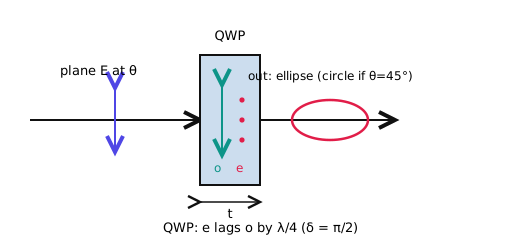
A thin slice of a double-refracting crystal (usually quartz), cut with its faces parallel to the optic axis. The o-wave and e-wave travel the same path but at different speeds, so they leave with a fixed phase gap. A quarter-wave plate (QWP) is cut just thick enough to make that gap exactly 90° (π/2). It converts plane-polarized light into circular or elliptic light (and back).
Derivation (no jumps): time to cross the plate of thickness t is to = t/vo = tμo/c for the o-wave and te = tμe/c for the e-wave [because v = c/μ]. The optical-path difference is |μe − μo|·t. The phase difference from a path difference Δ is δ = (2π/λ)·Δ, so
A QWP needs δ = π/2 (a quarter of a full 2π cycle, hence "quarter-wave"). Setting δ = π/2 in Formula 3 and solving for t gives
Unit + dimension check: λ is a length L and |Δμ| is a pure number, so t has dimension L ✓. Limiting check: a larger birefringence |Δμ| gives a thinner plate — sensible.
Find the thickness of a quarter-wave plate for sodium light λ = 589.6 nm with μo = 1.544, μe = 1.553. 2024
Recall
Steps
- Given — λ = 589.6 nm = 589.6 × 10⁻⁹ m; μo = 1.544, μe = 1.553 [list values with units first].
- Birefringence — |Δμ| = |1.553 − 1.544| = 0.009 [retardation depends on the index difference].
- Formula — from Formula 3 with δ = π/2, the thickness is t = λ / (4 · |Δμ|) [quarter-wave condition].
- Substitute — t = 589.6 / (4 × 0.009) nm = 589.6 / 0.036 nm [because 4 × 0.009 = 0.036].
- Divide — 0.036 × 16 377.78 ≈ 589.6, so t ≈ 16 377.8 nm [long-division rough work shown].
- Convert for sense — 16 377.8 nm ≈ 16.38 μm, a thin foil, reasonable for a retardation plate [because 1 μm = 1000 nm].
Answer
Exam tip
Find the thickness of a quartz quarter-wave plate for λ = 5.9 × 10⁻⁵ cm with μo = 1.544, μe = 1.535. 2022
Recall
Steps
- Given — λ = 5.9 × 10⁻⁵ cm; μo = 1.544, μe = 1.535 (use the paper values) [list first].
- Birefringence — |Δμ| = |1.535 − 1.544| = 0.009 [thickness needs the magnitude; the sign only tells which ray is faster].
- Formula — t = λ / (4 · |Δμ|) = 5.9 × 10⁻⁵ / (4 × 0.009) cm [Formula 4].
- Denominator — 4 × 0.009 = 0.036 = 36 × 10−3 [tidy the powers].
- Divide — t = (5.9 / 0.036) × 10−5 ≈ 163.89 × 10⁻⁵ cm [because 0.036 × 163.89 ≈ 5.9].
- Tidy — 163.89 × 10−5 = 1.6389 × 10⁻³ cm ≈ 16.4 μm, the same plate as Q4a in different units, as expected for the same |Δμ| [because 1 cm = 104 μm].
Answer
Exam tip
5. Making + testing elliptic and circular light (Nicol + QWP)
A Nicol gives plane-polarized light; a QWP adds a fixed 90° phase shift between its two components. Together they build every polarization type. Daily example: a 3D-cinema glass uses exactly this pair, with opposite circular handedness for the two eyes.
Production (write in this order): pass unpolarized light through a Nicol to get plane-polarized E of amplitude E0 [because the Nicol is the polarizer]. Send it through a QWP whose optic axis makes angle θ with E. Inside, E splits into Ee = E0 cos θ (along the axis) and Eo = E0 sin θ (across the axis) [because we resolve E along and across the axis]. The QWP retards one component by δ = π/2 [Formula 3 with QWP thickness]. Reading the output: θ = 45° gives equal amplitudes plus 90° → circularly polarized; any other θ gives unequal amplitudes plus 90° → elliptically polarized [equal + quadrature = circle, unequal + quadrature = ellipse].
Testing (rotate a second Nicol = analyzer): circular light gives constant intensity on rotation (perfect symmetry); elliptic or partially polarized light gives intensity that varies but never hits zero; plane-polarized light gives intensity zero twice per turn. To confirm circular (not unpolarized, which is also constant): first pass the light through a QWP — circular becomes plane and then shows extinction on rotation, while unpolarized stays constant [because the QWP undoes its own 90° shift].
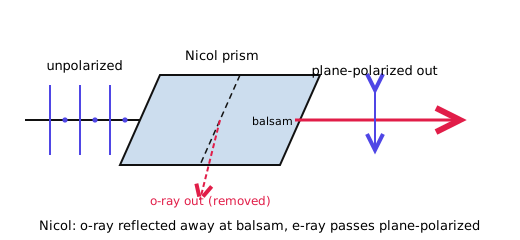
How will you prepare elliptically and circularly polarized light using a Nicol prism and a quarter-wave plate? How do you test them? 2019
Recall
Steps
- Polarizer — pass unpolarized light through a Nicol to get plane-polarized light, vibrations along the Nicol principal section [because everything else is removed].
- Retarder — pass it through a QWP with axis at angle θ to E. Components: Ee = E0 cos θ and Eo = E0 sin θ; phase gap δ = π/2 from Formula 3 [resolution plus quarter-wave retardation].
- Choose circular — θ = 45° makes Ee = Eo, combined with the 90° shift gives a rotating vector of fixed length = circularly polarized light [equal + quadrature = circle].
- Choose elliptic — θ ≠ 45° (for example 30°) gives unequal amplitudes with 90° = elliptically polarized light [unequal + quadrature = ellipse].
- Test with analyzer Nicol — circular gives constant intensity, elliptic gives varying-but-never-zero [plane → zero twice per turn]. To separate circular from unpolarized, insert a QWP before the analyzer: circular turns plane (extinction appears), unpolarized is unaffected [rotation readings plus QWP undo-check].
Answer
Exam tip
6. Backup (syllabus-adjacent) — Malus law and Brewster angle
Neither formula appeared in the 2018–2024 polarization PYQs above, but both are one-line results that can support Q1 / Q5 answers. Learn them only after Sections 1–5 are solid.
Malus law. Plane-polarized light of intensity I0 falls on an analyzer whose pass-direction makes angle θ with E. The transmitted component is E = E0 cos θ, and intensity goes as amplitude squared, so
So crossed Nicols (θ = 90°) give zero; parallel (θ = 0) give full I0 [because only the along-axis component passes, and I ∝ E2]. Note: Malus needs polarized input — for unpolarized input the average gives I = I0/2 regardless of θ.
Brewster angle. Unpolarized light reflecting off glass is partially polarized; at one special incidence ip the reflected ray is fully plane polarized (vibrations perpendicular to the plane of incidence) and sits 90° from the refracted ray:
For glass μ = 1.5, ip = tan−1(1.5) ≈ 56.3° [because at ip the reflected and refracted rays are perpendicular, so the in-plane vibration has nowhere to go]. The reflected light is polarized perpendicular to the plane of incidence — state the direction explicitly.
Reference. Brij Lal, Subrahmanyam & Avadhanulu — Optics Ch-19 (transverse nature, Nicol prism), Ch-20 (double refraction, Huygens theory, quarter-wave plate, elliptic and circular light); Ajoy Ghatak — Optics Ch-19 (retardation plates, Malus law, Brewster law).