This page is about capacitors — how they store charge and energy. We start with the parallel-plate geometry, derive $C = \varepsilon_0 A/d$ and the energy $U = \tfrac{1}{2}CV^2$. Then we cover spherical and cylindrical capacitors, the half-in-oil numerical, and the energy loss when two charged capacitors share charge.
1. Parallel-plate capacitor
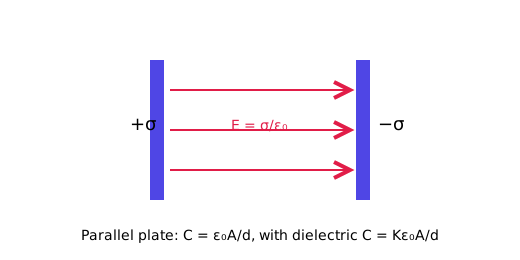
Two parallel plates, each of area $A$, separated by distance $d$, carry equal and opposite charges $\pm Q$. Surface density $\sigma = Q/A$. The field between the plates is uniform (we ignore edge effects):
The capacitance is defined as $C = Q/V$, so
1.1 Effect of a dielectric slab
Insert a dielectric slab of constant $K$ filling the gap. The field falls to $E = \sigma/(K\varepsilon_0)$, so the voltage $V = Ed$ falls by a factor $K$ at the same charge $Q$. Hence $C$ rises by a factor $K$:
2. Energy stored in a capacitor
To charge a capacitor, we move small amounts of charge $dq$ from one plate to the other against the voltage $v$ that builds up. At the moment when the charge on the plates is $q$, the voltage is $v = q/C$, and the work to add $dq$ is $dW = v\,dq$.
- At charge $q$, voltage $v = q/C$. Adding $dq$ costs work $dW = v\,dq = (q/C)\,dq$ (reason: work = voltage × charge moved).
- Integrate from $q = 0$ to $q = Q$: $U = \dfrac{1}{C}\!\int_0^Q q\,dq = \dfrac{1}{C}\cdot\dfrac{Q^2}{2} = \dfrac{Q^2}{2C}$.
- Use $Q = CV$: $U = \dfrac{(CV)^2}{2C} = \tfrac{1}{2}CV^2 = \tfrac{1}{2}QV$.
Equivalently, picture the charging as filling a $v$–$q$ triangle: stored energy is its area, $\tfrac{1}{2}\cdot Q \cdot V$.
Solved PYQs
Prove that the energy stored in a capacitor of capacitance $C$ is $\tfrac{1}{2}CV^2$, where $V$ is the potential.
2019Recall
Steps
- Start uncharged ($q = 0$). Move a small charge $dq$ against the voltage $v = q/C$: $dW = (q/C)\,dq$.
- Integrate $q = 0 \to Q$: $U = \dfrac{1}{C}\!\int_0^Q q\,dq = \dfrac{Q^2}{2C}$ (reason: $\int q\,dq = q^2/2$, evaluated gives $Q^2/2$).
- Substitute $Q = CV$: $U = \dfrac{(CV)^2}{2C} = \tfrac{1}{2}CV^2 = \tfrac{1}{2}QV$.
Answer
Exam tip
Show that the capacitance of a parallel-plate capacitor is $C = \varepsilon_0 A/d$. What changes if a slab of dielectric constant $K$ is introduced?
2018Recall
Steps
- Surface density $\sigma = Q/A$. Field between plates: $E = \sigma/\varepsilon_0 = Q/(\varepsilon_0 A)$ (reason: Gauss's law on a pillbox, uniform field, edges ignored).
- Voltage across the gap: $V = Ed = Q d/(\varepsilon_0 A)$.
- Capacitance: $C = Q/V = Q/(Q d/\varepsilon_0 A) = \varepsilon_0 A/d$ — Eq. (2).
- With dielectric slab: $E$ drops to $E/K$ at the same $Q$, so $V$ drops to $V/K$, and $C \to K C$ — Eq. (3).
Answer
Exam tip
Find the energy stored in a capacitor of capacitance 2 pF with potential 1 kV.
2018Recall
Steps
- Convert to SI: $C = 2$ pF $= 2\times 10^{-12}$ F and $V = 1$ kV $= 10^3$ V.
- Write the formula: $U = \tfrac{1}{2}CV^2$.
- Substitute: $U = 0.5\times 2\times 10^{-12}\times (10^3)^2 = 10^{-12}\times 10^6 = 10^{-6}$ J.
- Convert: $10^{-6}$ J $= 1\ \mu$J. The small energy is reasonable — pF is a tiny capacitance.
Answer
Exam tip
An air-filled parallel-plate capacitor has capacitance $C$. What will it be if immersed half in oil of dielectric constant 1.6?
2019Recall
Steps
- State the assumption: plates dipped vertically so the lower half is in oil and the upper half is in air — two regions side by side → parallel combination. (If oil filled the bottom half of the gap depth-wise, it would be series — but the vertical-dip reading is the standard one.)
- Each region has area $A/2$: $C_{\text{air}} = \varepsilon_0 (A/2)/d = C/2$ and $C_{\text{oil}} = K\varepsilon_0 (A/2)/d = KC/2$.
- Parallel sum: $C' = C/2 + KC/2 = C(1+K)/2 = C(1+1.6)/2 = C(2.6)/2 = 1.3\,C$.
- Limit check: $K = 1$ (pure air) gives $C' = C$. ✓
Answer
Exam tip
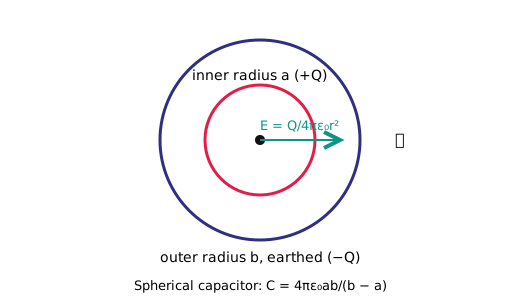
Capacitance of a spherical capacitor: two concentric metallic spheres, outer earthed. (2018: diameters 20 cm and 30 cm.)
×220182023Recall
Steps
- Let inner radius be $a$, outer radius be $b$. Charge $+Q$ sits on the inner sphere; $-Q$ is induced on the inside of the outer sphere (reason: the outer sphere is earthed, so its outer surface carries no net charge).
- Potential difference: $V = \int_a^b E\,dr = \dfrac{Q}{4\pi\varepsilon_0}\!\int_a^b\!\dfrac{dr}{r^2} = \dfrac{Q}{4\pi\varepsilon_0}\!\left(\dfrac{1}{a} - \dfrac{1}{b}\right) = \dfrac{Q(b-a)}{4\pi\varepsilon_0 ab}$.
- Capacitance: $C = Q/V = \dfrac{4\pi\varepsilon_0 ab}{b-a}$. Limit: $b \to \infty$ gives $4\pi\varepsilon_0 a$ (isolated sphere). ✓
- 2018 numbers: diameters 20 cm and 30 cm → radii $a = 0.10$ m, $b = 0.15$ m. $b - a = 0.05$ m. Substitute: $C = 4\pi\times 8.85\times 10^{-12}\times (0.10\times 0.15)/0.05 = 33.3$ pF.
Answer
Exam tip
Find the capacitance per unit length of a cylindrical capacitor, the outer cylinder being earthed.
2019Recall
Steps
- Inner radius $a$, outer radius $b$, outer cylinder earthed. A coaxial Gaussian cylinder gives $E = \lambda/2\pi\varepsilon_0 r$ between the conductors (reason: cylindrical symmetry, flux only through the curved face).
- Potential difference: $V = \int_a^b E\,dr = \dfrac{\lambda}{2\pi\varepsilon_0}\!\int_a^b\!\dfrac{dr}{r} = \dfrac{\lambda}{2\pi\varepsilon_0}\ln(b/a)$ (reason: $\int dr/r = \ln r$, evaluated gives $\ln b - \ln a = \ln(b/a)$).
- Charge on length $l$ is $\lambda l$. Total capacitance: $C = \dfrac{\lambda l}{V} = \dfrac{2\pi\varepsilon_0 l}{\ln(b/a)}$.
- Per unit length: $C/l = 2\pi\varepsilon_0/\ln(b/a)$. Unit: F/m. Limit: thin gap ($b \approx a$) gives a large $C$, as expected.
Answer
Exam tip
Two capacitors $C_1, C_2$ charged to potentials $V_1, V_2$ are connected together. Calculate the loss of energy on sharing of charges.
2022Recall
Steps
- Initial energy: $U_i = \tfrac{1}{2}C_1 V_1^2 + \tfrac{1}{2}C_2 V_2^2$.
- After connection, total charge $Q = C_1 V_1 + C_2 V_2$ spreads over $C_1 + C_2$ (reason: charge conservation, same polarity). Common voltage: $V = (C_1 V_1 + C_2 V_2)/(C_1 + C_2)$.
- Final energy: $U_f = \tfrac{1}{2}(C_1 + C_2)V^2 = \tfrac{1}{2}\dfrac{(C_1 V_1 + C_2 V_2)^2}{C_1 + C_2}$.
- Difference: $\Delta U = U_i - U_f = \tfrac{1}{2}C_1 V_1^2 + \tfrac{1}{2}C_2 V_2^2 - \tfrac{1}{2}\dfrac{(C_1 V_1 + C_2 V_2)^2}{C_1 + C_2}$. Expand and simplify: $\Delta U = \dfrac{C_1 C_2\,(V_1 - V_2)^2}{2(C_1 + C_2)}$.
- Limit check: $V_1 = V_2 \Rightarrow \Delta U = 0$. ✓ The loss is non-negative and zero only when the voltages already match.
Answer
Exam tip
Reference. Brij Lal & Subrahmanyam, Electricity & Magnetism Ch-4 (capacitance, energy); S.L. Arora Vol-1 Ch-2.