This page covers wavefronts and Huygens’ construction. It has three short theory sections, two figures, and one solved PYQ (asked three times).
1. Wavefront: definition + three types
Freeze a wave and mark all points swinging exactly together (same phase). The surface joining them is the wavefront. Light is an EM wave (from Maxwell), so it has wavefronts.
A wavefront is a surface of constant phase, always perpendicular to the rays.
Three types
- Spherical — point source nearby. Ripples on a pond after a stone drop; rays point outward radially.
- Plane — source very far (sunlight). Parallel rays, flat fronts. A small piece of a big sphere looks flat (curvature $\approx 1/R \to 0$ as $R \to \infty$).
- Cylindrical — line source (long slit). Tube-shaped fronts spreading sideways.
2. Huygens principle: three rules
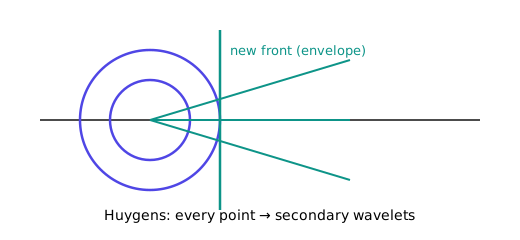
A construction rule that builds tomorrow’s wavefront from today’s one, using small imaginary ripples.
The three rules:
- Every point on a wavefront acts as a fresh source of secondary wavelets spreading at the wave speed $v$.
- The forward tangent surface (envelope) of these wavelets after time $t$ is the new wavefront.
- Wavelet amplitude is maximum forward and falls to zero backward (added by Stokes; explains why light goes forward only).
What it explains: reflection, refraction (Snell law, Section 3), interference, diffraction, polarization direction — qualitatively.
3. Refraction proof (Snell law) + reflection sketch
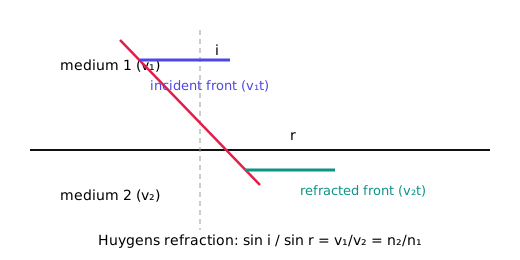
Snell law from wavelet speeds: a slower medium bends the front.
Refraction proof
Plane front AB hits the boundary at angle of incidence $i$. Point A enters medium 2 first and sends a wavelet of radius $v_2 t$; point B still travels in medium 1 covering $v_1 t$ before entering. The new front is the tangent from B’s position to A’s wavelet (Huygens envelope). From the two right triangles sharing the boundary intercept $L$: $\sin i = v_1 t/L$ and $\sin r = v_2 t/L$. Divide ($t$ and $L$ cancel) to get $\sin i/\sin r = v_1/v_2 = n_2/n_1$.
Reflection sketch
Same construction with one medium: incident front AB, A reflects first with wavelet $vt$, B covers $vt$ along the surface. Triangles are congruent (same speed $v$ both sides), so angle of incidence = angle of reflection.
Solved PYQ
State (and explain) Huygens' principle. (2024 couples it with "dual character of light" — that half is NOT in your syllabus)
201920222024×3 Recall- Define wavefront + give one type (e.g. spherical for a point source) (reason: sets up what the rules act on).
- State rule 1: every point on the wavefront is a fresh source of secondary wavelets at speed $v$ (reason: needed to build the new front).
- State rule 2: the forward envelope of these wavelets after time $t$ is the new wavefront (reason: defines where the wave is at the next instant).
- State rule 3: amplitude is maximum forward, zero backward (Stokes) (reason: kills the back-wave that geometry would otherwise allow).
- Draw secondary wavelets + forward envelope (reason: the question asks to "explain").
- One use: derive Snell law $n_1\sin i = n_2\sin r$ from wavelet speeds $v_1$, $v_2$ (reason: shows you can apply the principle).
Reference. Brij Lal, Subrahmanyam & Avadhanulu — A Textbook of Optics Ch-12; Ajoy Ghatak Ch-2 (wavefronts).