This page is about dielectric materials — insulators that respond to an applied field by developing tiny dipoles inside. We define the polarization vector $\vec{P}$, derive the central relation $\vec{D} = \varepsilon_0\vec{E} + \vec{P}$ from a slab picture, and distinguish polar from non-polar dielectrics. We also show why the field falls when a slab is inserted between capacitor plates.
1. Polarization of a dielectric
A dielectric is an insulator (glass, oil, plastic). Its molecules have no free charges. Under an external electric field, each molecule either rotates or stretches into a tiny dipole. The polarization vector is the total dipole moment per unit volume:
There are two response types. Polar molecules (H₂O, HCl, NH₃) have permanent dipoles that partly align with the field against thermal disorder. Non-polar molecules (H₂, O₂, N₂) have no permanent dipole — the field induces one, $\vec{p} = \alpha\vec{E}$. The medium stays neutral overall: equal induced $+q$ and $-q$ appear on its two faces.
2. The relation $\vec{D} = \varepsilon_0\vec{E} + \vec{P}$
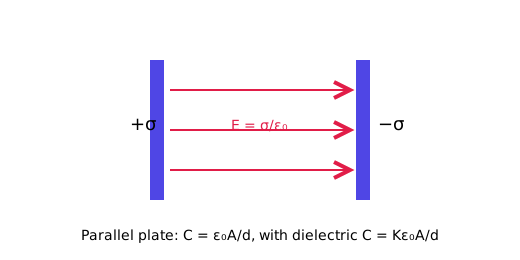
Three fields are in play. $\vec{D}$ is the displacement linked to the free charge on the plates: $D = \sigma_{\text{free}}$. $\vec{P}$ is the response of the medium — bound dipoles per unit volume. $\vec{E}$ is the net field a test charge feels.
2.1 Slab derivation
Insert a dielectric slab between the capacitor plates. Bound charges $\pm\sigma_p$ appear on the two faces of the slab. We work out the net field.
- Slab in the gap: bound charges $\pm\sigma_p$ appear on its two faces (reason: molecular dipoles line up; interior charges cancel, only the surface layers survive).
- Two sheet fields superpose: free $\sigma$ drives one way, bound $\sigma_p$ drives back. Net field $E = (\sigma_{\text{free}} - \sigma_p)/\varepsilon_0$.
- Identify the two terms: $D = \sigma_{\text{free}}$ and $P = \sigma_p$ (proved in Q3 below). So $\varepsilon_0 E = D - P$.
- Rearrange: $\boxed{\vec{D} = \varepsilon_0\vec{E} + \vec{P}}$.
- Gauss's law in a dielectric uses free charge only: $\boxed{\oint \vec{D}\cdot d\vec{S} = Q_{\text{free}}}$.
Solved PYQs
Write the relation between $\vec{D}$, $\vec{P}$ and $\vec{E}$ in a dielectric; define them and show $\vec{D} = \varepsilon_0\vec{E} + \vec{P}$.
×3201820192023Recall
Steps
- Define each quantity with units: $\vec{D}$ — displacement linked to free charge on the plates, $D = \sigma_{\text{free}}$, unit C/m². $\vec{P}$ — dipole moment per unit volume of the dielectric, unit C/m². $\vec{E}$ — net field a test charge feels, unit N/C.
- Place a slab between the plates: bound charges $\pm\sigma_p$ appear on its two faces. Net field: $E = (\sigma_{\text{free}} - \sigma_p)/\varepsilon_0$ (reason: superposition of the two sheet fields).
- Identify terms: $D = \sigma_{\text{free}}$ and $P = \sigma_p$ (proved in Q3). So $\varepsilon_0 E = D - P$.
- Rearrange: $\boxed{\vec{D} = \varepsilon_0\vec{E} + \vec{P}}$. Add the linear case $\vec{D} = \varepsilon\vec{E}$ and the free-charge Gauss law $\oint \vec{D}\cdot d\vec{S} = Q_{\text{free}}$.
Answer
Exam tip
What do you mean by polarization of a dielectric medium? Define the polarization vector.
2023Recall
Steps
- Meaning: an external field stretches or aligns the molecules of the dielectric into tiny dipoles. The medium gains bound surface charge on its faces, but stays neutral overall (equal $+q$ and $-q$).
- Define $\vec{P} = \sum\vec{p}/\Delta V$, the dipole moment per unit volume. Direction: from $-$ to $+$ inside the dielectric.
- Unit: C/m² (C·m ÷ m³). For linear media: $\vec{P} = \varepsilon_0\chi_e\vec{E}$.
Answer
Exam tip
Show that the magnitude of polarization equals the surface density of induced (bound) charge.
2019Recall
Steps
- Take a slab of area $A$ and thickness $d$, containing $N$ aligned molecular dipoles of charge $q$ and tip-to-tip separation $x$. Total dipole moment of the slab: $N q x$ (reason: moments of identical dipoles add).
- By definition: $P = \dfrac{N q x}{A d}$ (reason: divide the total moment by the volume $A d$).
- Bound charge on one face: each dipole deposits $+q$ on one face and $-q$ on the other. Total $N q$ spreads over area $A$, giving $\sigma_p = \dfrac{N q}{A}$ — but to relate it to $P$, note that shifting $N q$ across the slab thickness $d$ deposits charge $N q$ on the face of area $A$: $\sigma_p = \dfrac{N q x}{A d}$ (reason: charge × shift per volume = charge per area).
- Compare with step 2: $\sigma_p = P$. ✓
Answer
Exam tip
Distinguish between polar and non-polar dielectrics. Give examples.
2019Recall
Steps
- Polar dielectrics: molecules have a permanent $\vec{p} \neq 0$ even at zero field (reason: centres of positive and negative charge do not coincide, e.g. bent H₂O, HCl, NH₃). Without field, thermal motion randomises the orientations → net $P = 0$. A field partly aligns them against thermal disorder, so the effect falls as temperature rises.
- Non-polar dielectrics: molecules have symmetric charge centres, so $\vec{p} = 0$ at $E = 0$ (reason: positive and negative centres coincide, e.g. H₂, O₂, N₂, CO₂). An applied field stretches them: induced $\vec{p} = \alpha\vec{E}$, almost independent of temperature.
- Tabulate: permanent $\vec{p}$ vs zero $\vec{p}$; alignment vs stretching; temperature dependent vs not; examples on each side.
Answer
Exam tip
Show that the electric field decreases when a dielectric slab is introduced between the plates of a capacitor.
2023Recall
Steps
- Before the slab: air-filled, $E_0 = \sigma/\varepsilon_0$ (reason: field of a single charged sheet, by Gauss's law on a pillbox).
- After inserting the slab: bound charges $\pm\sigma_p$ appear on the two faces, with $\sigma_p$ opposite in sign to the adjacent free charge $\sigma$ (reason: dipoles align against the field).
- Net field at any point in the gap: $E = (\sigma - \sigma_p)/\varepsilon_0 < E_0$ (reason: $\sigma_p > 0$ subtracts).
- With dielectric constant $K$: $E = E_0/K = \sigma/(K\varepsilon_0)$. Limit: $K = 1$ (air) gives $E = E_0$. ✓
Answer
Exam tip
Reference. Brij Lal & Subrahmanyam, Electricity & Magnetism Ch-5 (polarization, D–E–P, dielectrics in capacitors); S.L. Arora Vol-1 Ch-2.